NGC 2304
NGC 2304 is an open cluster in the constellation Gemini, magnitude 10.0, 4.8′ across.
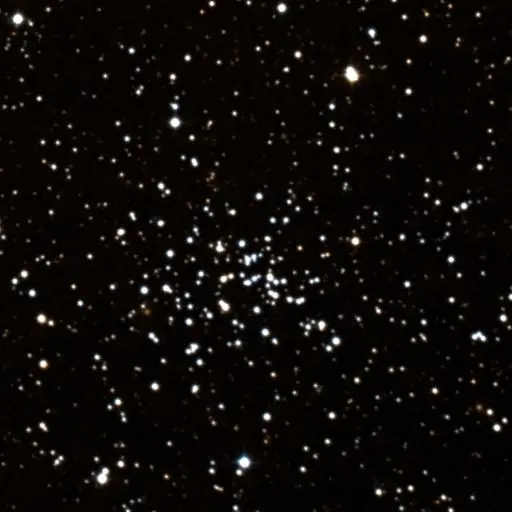
A small open cluster in Gemini — a family of stellar siblings in the constellation of the Twins.
In Greek myth, Gemini’s twins Castor and Pollux were inseparable brothers. The stars of an open cluster such as NGC 2304 are siblings too: born together from one cloud of gas, at the same time and from the same ingredients. Unlike the mythical twins, they will not stay together for ever — over time the galaxy’s gravity slowly pulls such families apart.
NGC 2304 is 12,000 light-years away: the light we see from it set off about 12,000 years ago, when the last Ice Age was ending.
How big is it?
Born about 910 million years ago, when there were no animals on Earth at all. Light itself takes 17 years to cross it. Gaia has picked out 201 stars moving together through space as its members. That’s 4 times the distance from the Sun to the nearest star. Shrink our Solar System — the Sun and all eight planets — to the size of a coin, and NGC 2304 would be 423 m across (4 football pitches end to end); the nearest star would be a football pitch away, and the Milky Way 2,520 km across.
A 10.0-magnitude open cluster in Gemini, about 4.8′ across.
When and where to see it
It is best placed in the evening sky around January, when it crosses the meridian at about 10 pm local time (around midnight in January). It can be seen from everywhere north of 72°S and never sets north of 72°N.
At its highest it stands 58° up from 50°N, 73° up from 35°N, 72° up from the equator, 37° up from 35°S.
Facts
- Type
- Open cluster
- Constellation
- Gemini
- Designations
- NGC 2304
- Magnitude
- 10.0
- Apparent size
- 4.8′
- Position
- RA 6h 55.2m, Dec +17° 60′ (J2000)
- Distance
- 12,000 light-years
Open AstroPilot to see when NGC 2304 is highest tonight from your location, how easy it is with your telescope or binoculars, and an eyepiece view.