Great Bird Cluster (NGC 2301)
Great Bird Cluster (NGC 2301) is an open cluster in the constellation Monoceros, magnitude 6.0, 10′ across.
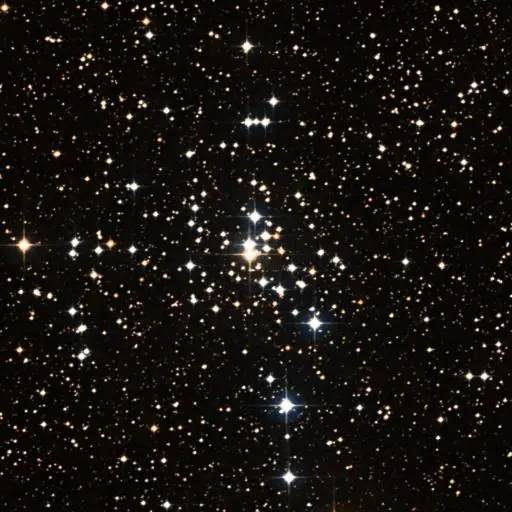
The Great Bird Cluster — a flock of stars on the Milky Way in Monoceros, with a possible orange interloper.
The Great Bird Cluster takes its name from the shape some see in its stars: a bird with its wings spread wide. NGC 2301 lies right on the band of the Milky Way in Monoceros, and this open cluster contains hot blue giants. Its brightest star is an orange subgiant, but it may not belong: it could be a foreground star that just happens to lie along the same line of sight. William Herschel discovered the cluster in 1786.
Great Bird Cluster (NGC 2301) is 2,700 light-years away: the light we see from it set off around 680 BC, around the time the first recorded Olympic Games were held.
How big is it?
Born about 210 million years ago, when dinosaurs were rising and the supercontinent Pangaea was breaking apart. Light itself takes 8 years to cross it. Gaia has picked out 828 stars moving together through space as its members. That’s 1.9 times the distance from the Sun to the nearest star. Shrink our Solar System — the Sun and all eight planets — to the size of a coin, and the Great Bird Cluster would be 202 m across (2 football pitches end to end); the nearest star would be a football pitch away, and the Milky Way 2,520 km across.
A 6.0-magnitude open cluster in Monoceros, about 10′ across.
When and where to see it
It is best placed in the evening sky around January, when it crosses the meridian at about 10 pm local time (around midnight in January). It sits on the celestial equator, so it can be seen from almost everywhere on Earth.
At its highest it stands 40° up from 50°N, 55° up from 35°N, 90° up from the equator, 55° up from 35°S.
Facts
- Type
- Open cluster
- Constellation
- Monoceros
- Designations
- NGC 2301
- Magnitude
- 6.0
- Apparent size
- 10′
- Position
- RA 6h 51.8m, Dec +0° 28′ (J2000)
- Distance
- 2,700 light-years
- Discovered
- William Herschel, 1786
Open AstroPilot to see when Great Bird Cluster (NGC 2301) is highest tonight from your location, how easy it is with your telescope or binoculars, and an eyepiece view.