NGC 2282 (IC 2172)
NGC 2282 (IC 2172) is an emission nebula in the constellation Monoceros, magnitude 10.0 (blue), 3.0′ × 3.0′ across.
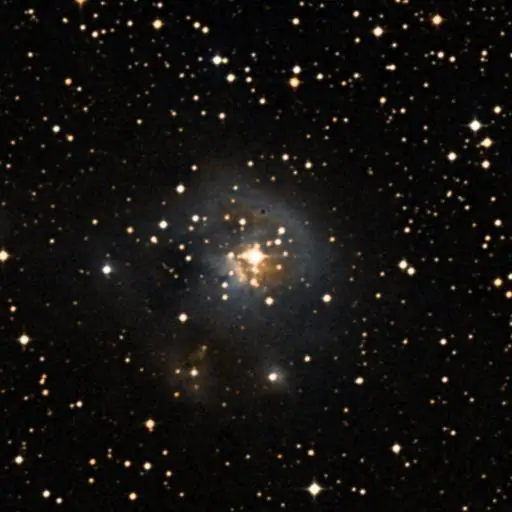
A small glowing cloud in Monoceros that made it into the catalogues twice, as NGC 2282 and IC 2172.
Some objects were recorded twice and ended up with two catalogue numbers. NGC 2282 is one of them: it also appears as IC 2172 in the Index Catalogue, the supplement J. L. E. Dreyer published to extend his New General Catalogue. It is a small nebula in Monoceros, a cloud of gas and dust lit by young stars, close to the plane of the Milky Way where new stars are born.
NGC 2282 (IC 2172) is 5,200 light-years away: the light we see from it set off around 3180 BC, around the time writing was invented in Mesopotamia.
How big is it?
About as wide as the distance from the Sun to the nearest star. Light itself takes 4.5 years to cross it. Shrink our Solar System — the Sun and all eight planets — to the size of a coin, and NGC 2282 would be 115 m across (about the length of a football pitch); the nearest star would be a football pitch away, and the Milky Way 2,520 km across.
A 10.0-magnitude (B-band) emission nebula in Monoceros, about 3′ across.
When and where to see it
It is best placed in the evening sky around January, when it crosses the meridian at about 10 pm local time (around midnight in January). It can be seen from everywhere north of 89°S.
At its highest it stands 41° up from 50°N, 56° up from 35°N, 89° up from the equator, 54° up from 35°S.
Facts
- Type
- Emission nebula
- Constellation
- Monoceros
- Designations
- IC 2172
- Magnitude
- 10.0 (blue)
- Apparent size
- 3.0′ × 3.0′
- Position
- RA 6h 46.9m, Dec +1° 19′ (J2000)
- Distance
- 5,200 light-years
Open AstroPilot to see when NGC 2282 (IC 2172) is highest tonight from your location, how easy it is with your telescope or binoculars, and an eyepiece view.