Christmas Tree Cluster (NGC 2264)
Christmas Tree Cluster (NGC 2264) is a cluster + nebula in the constellation Monoceros, magnitude 3.9, 40′ across.
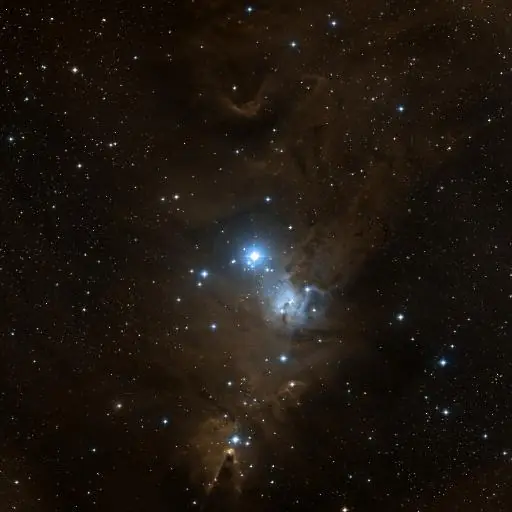
A Christmas tree of young stars topped by the Cone Nebula — and usually pictured upside down.
Join up the brightest stars of NGC 2264 and you get a Christmas tree, lit at its base by the brilliant star S Monocerotis and topped by the dark, pointed Cone Nebula. In the usual north-up view, the tree stands on its head. The open cluster and its glowing cloud of hydrogen share one catalogue number, and the same region holds the Snowflake Cluster and the Fox Fur Nebula.
Because it is relatively nearby and large, NGC 2264 is one of the best-studied star-forming regions in the sky. Young stars are still emerging from its clouds, and there may be one brown dwarf for every few ordinary stars.
Christmas Tree Cluster (NGC 2264) is 2,300 light-years away: the light we see from it set off around 280 BC, 165 years after the Parthenon was dedicated in Athens.
How big is it?
Born about 5.9 million years ago, when our ancestors and the chimpanzees' were going their separate ways. Light itself takes 27 years to cross it. Gaia has picked out 224 stars moving together through space as its members. That’s 6.3 times the distance from the Sun to the nearest star. Shrink our Solar System — the Sun and all eight planets — to the size of a coin, and the Christmas Tree Cluster would be 675 m across (6 football pitches end to end); the nearest star would be a football pitch away, and the Milky Way 2,520 km across.
A star cluster with nebulosity in Monoceros, about 40′ across. Its catalogued magnitude, 3.9, is that of the star cluster; the nebulosity is much fainter.
When and where to see it
It is best placed in the evening sky around January, when it crosses the meridian at about 10 pm local time (around midnight in December). It can be seen from everywhere north of 80°S and never sets north of 80°N.
At its highest it stands 50° up from 50°N, 65° up from 35°N, 80° up from the equator, 45° up from 35°S.
Facts
- Type
- Cluster + nebula
- Constellation
- Monoceros
- Designations
- NGC 2264, Mel 49, Cr 112, Cone Nebula, Melotte 49, Collinder 112
- Magnitude
- 3.9
- Apparent size
- 40′
- Position
- RA 6h 41.0m, Dec +9° 54′ (J2000)
- Distance
- 2,300 light-years
- Discovered
- William Herschel, 1784
Open AstroPilot to see when Christmas Tree Cluster (NGC 2264) is highest tonight from your location, how easy it is with your telescope or binoculars, and an eyepiece view.