Hubble's Variable Nebula (NGC 2261)
Hubble's Variable Nebula (NGC 2261) is a reflection nebula in the constellation Monoceros, magnitude 11.8, 2.0′ × 1.0′ across.
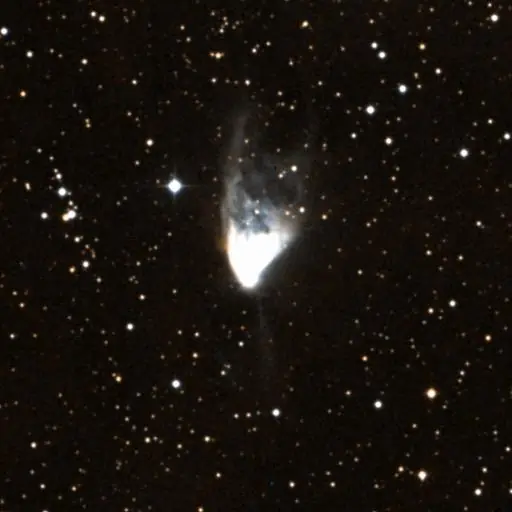
A nebula that changes from month to month — and the one Edwin Hubble kept coming back to.
Most nebulae look the same for a human lifetime. This one changes from month to month. NGC 2261 is a reflection nebula, a fan of dust lit by the young star R Monocerotis, which is itself hidden from direct view. One explanation for its shifting face is that dense clumps of dust close to the star block its light now and then, throwing moving shadows onto the cloud — like a hand passing in front of a lamp.
Edwin Hubble kept returning to it, and it now bears his name. In 1916 he photographed it with the Yerkes 24-inch reflector and compared his plates with ones F. C. Jordan had taken in 1908, flicking between them in a blink comparator to catch the changes. On 26 January 1949 he chose it again for the first light of the 200-inch Hale Telescope at Palomar.
William Herschel had first logged it on 26 December 1783, as a considerably bright, fan-shaped glow.
Hubble's Variable Nebula (NGC 2261) is 2,600 light-years away: the light we see from it set off around 580 BC, 135 years before the Parthenon was dedicated in Athens.
Did you know?
- Hubble meets Hubble. The space telescope named after the man who studied it photographed the nebula too. Its portrait of NGC 2261 was released in 1999.
- An amateur time-lapse. From October 2021 to April 2022 more than 20 amateur astronomers shared the Big Amateur Telescope to film NGC 2261 over six months, building a time-lapse of its changing face.
How big is it?
1,590 Solar Systems side by side. Light itself takes 1.5 years to cross it. Shrink our Solar System — the Sun and all eight planets — to the size of a coin, and Hubble's Variable Nebula would be 38.2 m across (about the length of an Olympic pool); the nearest star would be a football pitch away, and the Milky Way 2,520 km across.
A small, comet-shaped nebula lit by the young star R Monocerotis; its shape and brightness change over weeks as shadows move across it. It was the first object photographed with the Palomar 200-inch telescope.
When and where to see it
It is best placed in the evening sky around January, when it crosses the meridian at about 10 pm local time (around midnight in December). It can be seen from everywhere north of 81°S and never sets north of 81°N.
At its highest it stands 49° up from 50°N, 64° up from 35°N, 81° up from the equator, 46° up from 35°S.
Facts
- Type
- Reflection nebula
- Constellation
- Monoceros
- Designations
- NGC 2261, C 46, Hubble's Nebula
- Magnitude
- 11.8
- Apparent size
- 2.0′ × 1.0′
- Position
- RA 6h 39.2m, Dec +8° 45′ (J2000)
- Distance
- 2,600 light-years
- Discovered
- William Herschel, 1783
Open AstroPilot to see when Hubble's Variable Nebula (NGC 2261) is highest tonight from your location, how easy it is with your telescope or binoculars, and an eyepiece view.