NGC 2245
NGC 2245 is a reflection nebula in the constellation Monoceros, magnitude 11.0 (blue), 2.0′ × 2.0′ across.
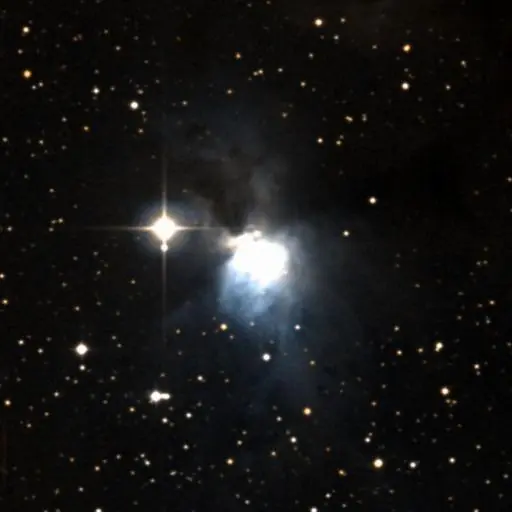
A small patch of reflected starlight in Monoceros, part of a young star-forming region.
Not every nebula makes its own light. NGC 2245 is a small reflection nebula, dust that glows only because it scatters the light of a young star at its centre. It belongs to Monoceros R1, a chain of dusty clouds and newborn stars that also includes its close neighbour NGC 2247 and the nebulae IC 446 and IC 447. Young stars and jets from newborn stars show that star birth is still under way here.
NGC 2245 is 2,100 light-years away: the light we see from it set off around 80 BC, 155 years before Vesuvius buried Pompeii.
How big is it?
1,280 Solar Systems side by side. Light itself takes about a year to cross it. Shrink our Solar System — the Sun and all eight planets — to the size of a coin, and NGC 2245 would be 30.8 m across (about the length of a tennis court); the nearest star would be a football pitch away, and the Milky Way 2,520 km across.
An 11.0-magnitude (B-band) reflection nebula in Monoceros, about 2′ across.
When and where to see it
It is best placed in the evening sky around January, when it crosses the meridian at about 10 pm local time (around midnight in December). It can be seen from everywhere north of 80°S and never sets north of 80°N.
At its highest it stands 50° up from 50°N, 65° up from 35°N, 80° up from the equator, 45° up from 35°S.
Facts
- Type
- Reflection nebula
- Constellation
- Monoceros
- Designations
- NGC 2245
- Magnitude
- 11.0 (blue)
- Apparent size
- 2.0′ × 2.0′
- Position
- RA 6h 32.7m, Dec +10° 9′ (J2000)
- Distance
- 2,100 light-years
Open AstroPilot to see when NGC 2245 is highest tonight from your location, how easy it is with your telescope or binoculars, and an eyepiece view.