Satellite Cluster (NGC 2244)
Satellite Cluster (NGC 2244) is an open cluster in the constellation Monoceros, magnitude 4.8, 24′ across.
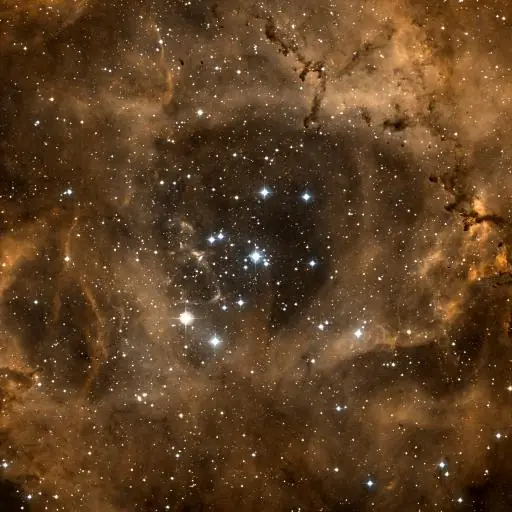
Newborn giants at the heart of the Rosette — blazing so fiercely they stunt the stars forming around them.
Less than five million years old, the stars of NGC 2244 are cosmic infants — an open cluster fresh from its nursery. They formed from the gas of the Rosette Nebula, which still wraps around them.
Its leaders are true heavyweights. HD 46223 has around 50 times the Sun’s mass and shines 400,000 times as brightly. HD 46150 may weigh up to 60 Suns and is brighter still — though it might really be two stars. Hot O-type stars like these pour out radiation and stellar winds that shape everything nearby.
The most obvious star in the cluster, 12 Monocerotis, is not a member at all. It is an orange giant much closer to us, lying in the foreground by chance.
Satellite Cluster (NGC 2244) is 4,600 light-years away: the light we see from it set off around 2580 BC, around the time the Great Pyramid of Giza was completed.
Did you know?
- Brown dwarfs in the glare. A 2023 study found that brown dwarfs here tend to form close to the hottest stars. Their fierce light may strip gas from cores that would otherwise have grown into ordinary stars.
- A disc blowing away. One young member shows signs of a planet-forming disc being eroded by the radiation around it, much like the proplyds seen in the Orion Nebula.
How big is it?
Born about 13 million years ago, when great apes were spreading through Africa and Europe. Light itself takes 32 years to cross it. Gaia has picked out 360 stars moving together through space as its members. That’s 7.6 times the distance from the Sun to the nearest star. Shrink our Solar System — the Sun and all eight planets — to the size of a coin, and the Satellite Cluster would be 810 m across (8 football pitches end to end); the nearest star would be a football pitch away, and the Milky Way 2,520 km across.
The young open cluster at the center of the Rosette Nebula (C49), easy in binoculars as a rectangle of bright stars; its hot stars make the surrounding gas glow.
When and where to see it
It is best placed in the evening sky around January, when it crosses the meridian at about 10 pm local time (around midnight in December). It can be seen from everywhere north of 85°S and never sets north of 85°N.
At its highest it stands 45° up from 50°N, 60° up from 35°N, 85° up from the equator, 50° up from 35°S.
Facts
- Type
- Open cluster
- Constellation
- Monoceros
- Designations
- NGC 2244, NGC 2239, C 50, Mel 47, Cr 99, Melotte 47, Collinder 99
- Magnitude
- 4.8
- Apparent size
- 24′
- Position
- RA 6h 31.9m, Dec +4° 57′ (J2000)
- Distance
- 4,600 light-years
- Discovered
- John Flamsteed, 1690
Open AstroPilot to see when Satellite Cluster (NGC 2244) is highest tonight from your location, how easy it is with your telescope or binoculars, and an eyepiece view.