NGC 2215
NGC 2215 is an open cluster in the constellation Monoceros, magnitude 8.4, 8.4′ across.
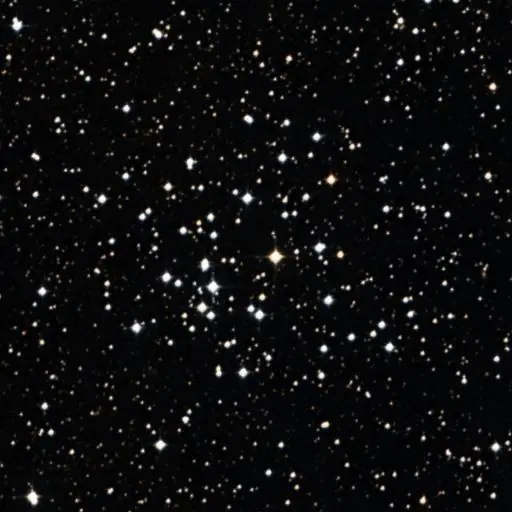
A small open cluster in Monoceros, the faint Unicorn that straddles the winter Milky Way.
Monoceros, the Unicorn, has no bright stars to speak of, yet it is rich in star clusters because the Milky Way runs right through it. NGC 2215 is one of those open clusters. The constellation itself is a newcomer: it first appeared on star maps in the early 17th century, drawn into the dim gap between Orion, Canis Major and Canis Minor.
NGC 2215 is 3,000 light-years away: the light we see from it set off around 980 BC, 200 years before the first recorded Olympic Games were held.
How big is it?
Born about 690 million years ago, when there were no animals on Earth at all. Light itself takes 7.3 years to cross it. Gaia has picked out 192 stars moving together through space as its members. That’s 1.7 times the distance from the Sun to the nearest star. Shrink our Solar System — the Sun and all eight planets — to the size of a coin, and NGC 2215 would be 185 m across (2 football pitches end to end); the nearest star would be a football pitch away, and the Milky Way 2,520 km across.
An 8.4-magnitude open cluster in Monoceros, about 8.4′ across.
When and where to see it
It is best placed in the evening sky around January, when it crosses the meridian at about 10 pm local time (around midnight in December). It can be seen from everywhere south of 83°N and never sets south of 83°S.
At its highest it stands 33° up from 50°N, 48° up from 35°N, 83° up from the equator, 62° up from 35°S.
Facts
- Type
- Open cluster
- Constellation
- Monoceros
- Designations
- NGC 2215
- Magnitude
- 8.4
- Apparent size
- 8.4′
- Position
- RA 6h 20.8m, Dec −7° 17′ (J2000)
- Distance
- 3,000 light-years
Open AstroPilot to see when NGC 2215 is highest tonight from your location, how easy it is with your telescope or binoculars, and an eyepiece view.