NGC 2194
NGC 2194 is an open cluster in the constellation Orion, magnitude 8.5, 8.7′ across.
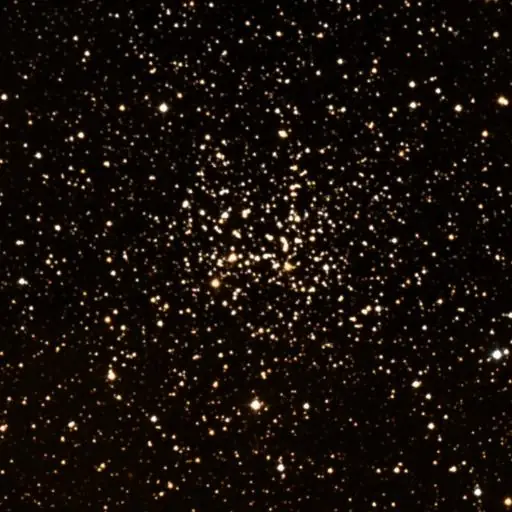
A rich cluster in Orion that was accidentally catalogued a second time, almost 80 years after its discovery.
William Herschel discovered NGC 2194 on 11 February 1784. Seventy-eight years later Heinrich d’Arrest came across it again, and J. L. E. Dreyer listed d’Arrest’s sighting in a supplement to the General Catalogue as a new object, without noticing it was already there. The open cluster itself is rich and moderately concentrated, a few hundred million years old by most estimates, and may contain blue stragglers — stars that look younger than their neighbours.
NGC 2194 is 10,000 light-years away: the light we see from it set off around 7980 BC, 1,530 years after the stone pillars of Göbekli Tepe, the oldest known temple, were raised.
How big is it?
Born about 340 million years ago, when the first plants and animals were moving onto land. Light itself takes 25 years to cross it. Gaia has picked out 1,113 stars moving together through space as its members. That’s 6 times the distance from the Sun to the nearest star. Shrink our Solar System — the Sun and all eight planets — to the size of a coin, and NGC 2194 would be 639 m across (6 football pitches end to end); the nearest star would be a football pitch away, and the Milky Way 2,520 km across.
An 8.5-magnitude open cluster in Orion, about 8.7′ across.
When and where to see it
It is best placed in the evening sky around January, when it crosses the meridian at about 10 pm local time (around midnight in December). It can be seen from everywhere north of 77°S and never sets north of 77°N.
At its highest it stands 53° up from 50°N, 68° up from 35°N, 77° up from the equator, 42° up from 35°S.
Facts
- Type
- Open cluster
- Constellation
- Orion
- Designations
- NGC 2194
- Magnitude
- 8.5
- Apparent size
- 8.7′
- Position
- RA 6h 13.8m, Dec +12° 48′ (J2000)
- Distance
- 10,000 light-years
- Discovered
- William Herschel, 1784
Open AstroPilot to see when NGC 2194 is highest tonight from your location, how easy it is with your telescope or binoculars, and an eyepiece view.