NGC 2175
NGC 2175 is a cluster + nebula in the constellation Orion, magnitude 6.8, 5.4′ across.
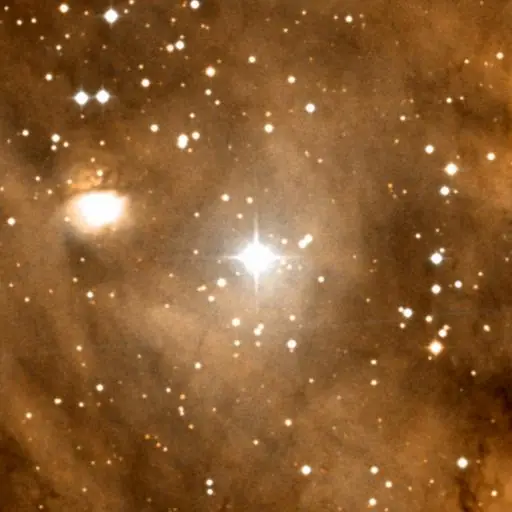
The young star cluster at the heart of the Monkey Head Nebula, only about nine million years old.
The stars that light up the Monkey Head Nebula belong to NGC 2175, a very young open cluster still embedded in the cloud it formed from. At about nine million years old, its stars are infants beside our 4.6-billion-year-old Sun. Giovanni Battista Hodierna, a priest-astronomer in Sicily, seems to have spotted it before 1654. In 1970 a second, smaller cluster, NGC 2175s, was found close by.
NGC 2175 is 5,800 light-years away: the light we see from it set off around 3780 BC, 570 years before writing was invented in Mesopotamia.
Did you know?
- Which number is which?. Catalogues disagree: NGC 2174 and NGC 2175 have each been used for the whole nebula, its brightest knot or the cluster. The SIMBAD database uses NGC 2174 for the nebula and NGC 2175 for the cluster.
How big is it?
2.1 times the distance from the Sun to the nearest star. Light itself takes 9.1 years to cross it. Gaia has picked out 32 stars moving together through space as its members. Shrink our Solar System — the Sun and all eight planets — to the size of a coin, and NGC 2175 would be 230 m across (2 football pitches end to end); the nearest star would be a football pitch away, and the Milky Way 2,520 km across.
A star cluster with nebulosity in Orion, about 5.4′ across. Its catalogued magnitude, 6.8, is that of the star cluster; the nebulosity is much fainter.
When and where to see it
It is best placed in the evening sky around January, when it crosses the meridian at about 10 pm local time (around midnight in December). It can be seen from everywhere north of 70°S and never sets north of 70°N.
At its highest it stands 60° up from 50°N, 75° up from 35°N, 70° up from the equator, 35° up from 35°S.
Facts
- Type
- Cluster + nebula
- Constellation
- Orion
- Designations
- NGC 2175
- Magnitude
- 6.8
- Apparent size
- 5.4′
- Position
- RA 6h 9.7m, Dec +20° 29′ (J2000)
- Distance
- 5,800 light-years
- Discovered
- Giovanni Battista Hodierna, Before 1654; found again independently by Karl Christian Bruhns
Open AstroPilot to see when NGC 2175 is highest tonight from your location, how easy it is with your telescope or binoculars, and an eyepiece view.