Monkey Head Nebula (NGC 2174)
Monkey Head Nebula (NGC 2174) is an emission nebula in the constellation Orion, 40′ × 30′ across.
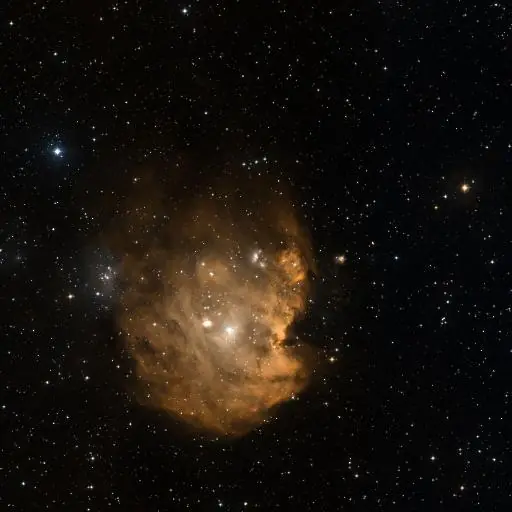
A monkey’s face in glowing gas, sculpted by the fierce light of the young stars inside it.
In long-exposure photographs this cloud of glowing hydrogen looks like the head of a monkey, hence its nickname, the Monkey Head Nebula. NGC 2174 is an emission nebula lit by the young stars of the cluster NGC 2175 near its centre. Their winds and high-energy radiation push the glowing gas and dark dust into ever more complex shapes. The French astronomer Édouard Stephan discovered it on 6 February 1877.
Monkey Head Nebula (NGC 2174) is 6,400 light-years away: the light we see from it set off around 4380 BC, 1,130 years after the first towns were growing in the Fertile Crescent.
Did you know?
- A Hubble birthday portrait. For its 24th anniversary in 2014, the Hubble Space Telescope released an infrared view of part of the nebula, showing knots of gas and dust being carved by the young stars.
How big is it?
18 times the distance from the Sun to the nearest star. Light itself takes 74 years to cross it. Shrink our Solar System — the Sun and all eight planets — to the size of a coin, and the Monkey Head Nebula would be 1.88 km across (a 25-minute walk); the nearest star would be a football pitch away, and the Milky Way 2,520 km across.
An emission nebula in Orion, about 40′ × 30′.
When and where to see it
It is best placed in the evening sky around January, when it crosses the meridian at about 10 pm local time (around midnight in December). It can be seen from everywhere north of 69°S and never sets north of 69°N.
At its highest it stands 61° up from 50°N, 76° up from 35°N, 69° up from the equator, 34° up from 35°S.
Facts
- Type
- Emission nebula
- Constellation
- Orion
- Designations
- NGC 2174
- Apparent size
- 40′ × 30′
- Position
- RA 6h 9.4m, Dec +20° 40′ (J2000)
- Distance
- 6,400 light-years
- Discovered
- Édouard Stephan, 1877
Open AstroPilot to see when Monkey Head Nebula (NGC 2174) is highest tonight from your location, how easy it is with your telescope or binoculars, and an eyepiece view.