NGC 2129
NGC 2129 is an open cluster in the constellation Gemini, magnitude 6.7, 3.9′ across.
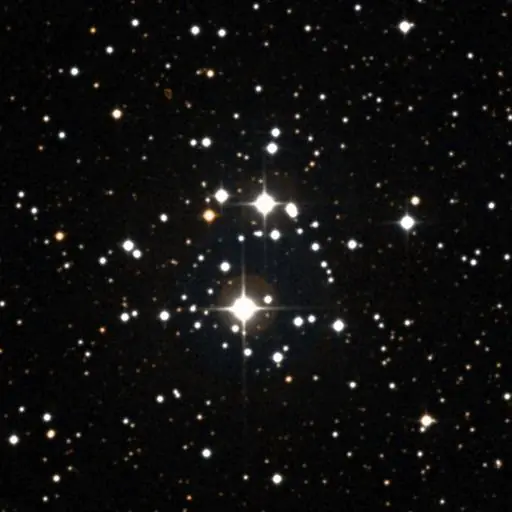
A young cluster in Gemini that the Moon covered during a total lunar eclipse — and will again in 2029.
On 21 December 2010, as the Moon slid through Earth’s shadow in a total lunar eclipse, it also passed in front of NGC 2129 — an occultation seen from Japan, the North Pacific and North America. The coincidence will repeat during the December 2029 eclipse and again on 21 December 2094. The open cluster itself is young, about 10 million years old, and dominated by two hot B-type stars that probably orbit each other.
NGC 2129 is 6,100 light-years away: the light we see from it set off around 4080 BC, 870 years before writing was invented in Mesopotamia.
How big is it?
Born about 17 million years ago, when great apes were spreading through Africa and Europe. Light itself takes 6.9 years to cross it. Gaia has picked out 145 stars moving together through space as its members. That’s 1.6 times the distance from the Sun to the nearest star. Shrink our Solar System — the Sun and all eight planets — to the size of a coin, and NGC 2129 would be 175 m across (2 football pitches end to end); the nearest star would be a football pitch away, and the Milky Way 2,520 km across.
A 6.7-magnitude open cluster in Gemini, about 3.9′ across.
When and where to see it
It is best placed in the evening sky around January, when it crosses the meridian at about 10 pm local time (around midnight in December). It can be seen from everywhere north of 67°S and never sets north of 67°N.
At its highest it stands 63° up from 50°N, 78° up from 35°N, 67° up from the equator, 32° up from 35°S.
Facts
- Type
- Open cluster
- Constellation
- Gemini
- Designations
- NGC 2129
- Magnitude
- 6.7
- Apparent size
- 3.9′
- Position
- RA 6h 1.1m, Dec +23° 19′ (J2000)
- Distance
- 6,100 light-years
- Discovered
- William Herschel, 1784
Open AstroPilot to see when NGC 2129 is highest tonight from your location, how easy it is with your telescope or binoculars, and an eyepiece view.