Tarantula Nebula (NGC 2070)
Tarantula Nebula (NGC 2070) is an emission nebula in the constellation Dorado, magnitude 7.3, 40′ × 25′ across.
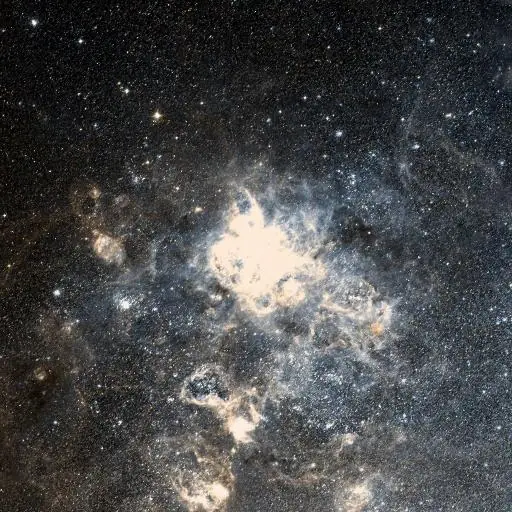
A nebula so luminous that, as close as Orion’s, it would cast shadows — powered by some of the heaviest stars known.
Move the Tarantula to where the Orion Nebula sits and its light would cast shadows at night. That is how luminous this cloud of glowing gas is. The Tarantula is a vast emission nebula in the Large Magellanic Cloud, one of the small galaxies that accompany our own. Its spidery loops are lit mostly by one fierce star cluster at its heart, NGC 2070.
At the cluster’s core sits R136, one of the most energetic star clusters known. Among its members is R136a1, one of the most massive stars ever weighed: hundreds of times the Sun’s mass and millions of times as bright. Stars this heavy burn out within a few million years.
Nicolas-Louis de Lacaille recorded it in 1752 while mapping the southern sky from the Cape of Good Hope. Its other name, 30 Doradus, is the kind of number usually given to a star.
Tarantula Nebula (NGC 2070) is 160,000 light-years away: the light we see from it set off about 160,000 years ago, when our species still lived mostly in Africa.
Did you know?
- A supernova on the doorstep. In February 1987 a star on the outskirts of the Tarantula exploded. SN 1987A was the nearest supernova seen since the invention of the telescope, and southern observers could see it with the naked eye.
- Webb’s spider. In 2022 the James Webb Space Telescope photographed the Tarantula in infrared light, revealing thousands of young stars that had been hidden inside its dust.
How big is it?
439 times the distance from the Sun to the nearest star. Light itself takes 1,860 years to cross it. Shrink our Solar System — the Sun and all eight planets — to the size of a coin, and the Tarantula Nebula would be 47 km across (a 35-minute drive); the nearest star would be a football pitch away, and the Milky Way 2,520 km across.
The brightest star-forming region in the Local Group, in the Large Magellanic Cloud about 160,000 light-years away; binoculars show it as a bright knot in the LMC, and telescopes its spidery loops.
When and where to see it
It is best placed in the evening sky around January, when it crosses the meridian at about 10 pm local time (around midnight in December). It can be seen from everywhere south of 21°N and never sets south of 21°S.
At its highest it stands below the horizon from 50°N, below the horizon from 35°N, 21° up from the equator, 56° up from 35°S.
Facts
- Type
- Emission nebula
- Constellation
- Dorado
- Designations
- NGC 2070, C 103, 30 Doradus Cluster, 30 Doradus
- Magnitude
- 7.3
- Apparent size
- 40′ × 25′
- Position
- RA 5h 38.7m, Dec −69° 6′ (J2000)
- Distance
- 160,000 light-years
- Discovered
- Nicolas-Louis de Lacaille, 1752
Open AstroPilot to see when Tarantula Nebula (NGC 2070) is highest tonight from your location, how easy it is with your telescope or binoculars, and an eyepiece view.