NGC 2060
NGC 2060 is a supernova remnant in the constellation Dorado, magnitude 9.6, 2.2′ × 2.0′ across.
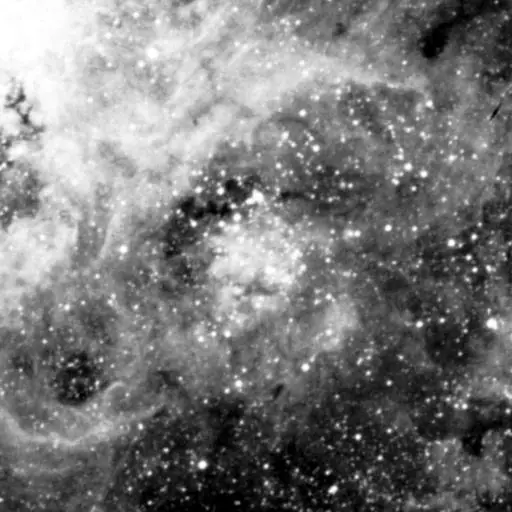
A star cluster in the Tarantula Nebula, wrapped in the wreck of a supernova that left a spinning pulsar.
Deep in the Tarantula Nebula, beside its giant central cluster, lies NGC 2060: a loose group of stars about 10 million years old, sitting inside a bubble blown by stellar winds or old explosions. The name is often used for the supernova remnant N157B, the debris of a star that, as seen from Earth, blew up about 5,000 years ago. In 1998 astronomers found what the explosion left behind: a pulsar spinning more than 60 times a second.
NGC 2060 is 160,000 light-years away: the light we see from it set off about 160,000 years ago, when our species still lived mostly in Africa.
Did you know?
- A runaway partner. VFTS 102, a massive star found speeding through the area, may once have been the pulsar’s companion — flung away when the supernova tore their pair apart.
- Stars at the very beginning. NGC 2060 is one of the few places to find OVz stars, massive stars thought to be caught at a very early stage of their lives.
How big is it?
24 times the distance from the Sun to the nearest star. Light itself takes 102 years to cross it. Shrink our Solar System — the Sun and all eight planets — to the size of a coin, and NGC 2060 would be 2.58 km across (a 30-minute walk); the nearest star would be a football pitch away, and the Milky Way 2,520 km across.
A 9.6-magnitude supernova remnant in Dorado, about 2.2′ × 2′.
When and where to see it
It is best placed in the evening sky around January, when it crosses the meridian at about 10 pm local time (around midnight in December). It can be seen from everywhere south of 21°N and never sets south of 21°S.
At its highest it stands below the horizon from 50°N, below the horizon from 35°N, 21° up from the equator, 56° up from 35°S.
Facts
- Type
- Supernova remnant
- Constellation
- Dorado
- Designations
- NGC 2060
- Magnitude
- 9.6
- Apparent size
- 2.2′ × 2.0′
- Position
- RA 5h 37.8m, Dec −69° 10′ (J2000)
- Distance
- 160,000 light-years
- Discovered
- John Herschel, 1836
Open AstroPilot to see when NGC 2060 is highest tonight from your location, how easy it is with your telescope or binoculars, and an eyepiece view.