Flame Nebula (NGC 2024)
Flame Nebula (NGC 2024) is an emission nebula in the constellation Orion, 30′ × 30′ across.
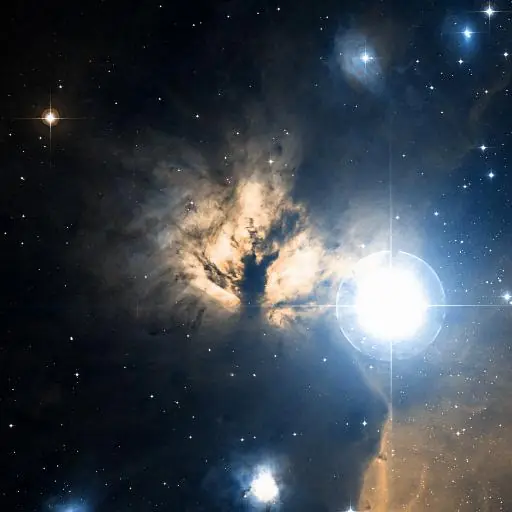
A fire beside Orion’s Belt — though the bright star next to it has nothing to do with the flames.
Beside Alnitak, the eastern star of Orion’s Belt, a glow laced with dark dust looks like a burning fire. Alnitak seems to light it, but the two are not connected. The real power source is hidden: an O-type star called IRS 2b, buried in dust at the heart of a young cluster, whose ultraviolet light makes the gas of this emission nebula shine.
Infrared and X-ray telescopes have uncovered several hundred young stars inside, out of an estimated 800.
Flame Nebula (NGC 2024) is 1,400 light-years away: the light we see from it set off around AD 630, 90 years after the Hagia Sophia was completed in Constantinople.
Did you know?
- A nursery of planet-forming discs. About 86 percent of the young, low-mass stars around the central hot star are still wrapped in discs of gas and dust — the raw material of planets.
- Two generations. Radio observations with ALMA reveal two groups split by a molecular cloud: an eastern group just 200,000 to 500,000 years old, and a western one around a million years old.
How big is it?
2.9 times the distance from the Sun to the nearest star. Light itself takes 12 years to cross it. Shrink our Solar System — the Sun and all eight planets — to the size of a coin, and the Flame Nebula would be 308 m across (3 football pitches end to end); the nearest star would be a football pitch away, and the Milky Way 2,520 km across.
An emission nebula in Orion, about 30′ across.
When and where to see it
It is best placed in the evening sky around January, when it crosses the meridian at about 10 pm local time (around midnight in December). It can be seen from everywhere south of 88°N and never sets south of 88°S.
At its highest it stands 38° up from 50°N, 53° up from 35°N, 88° up from the equator, 57° up from 35°S.
Facts
- Type
- Emission nebula
- Constellation
- Orion
- Designations
- NGC 2024
- Apparent size
- 30′ × 30′
- Position
- RA 5h 41.7m, Dec −1° 51′ (J2000)
- Distance
- 1,400 light-years
- Discovered
- William Herschel, 1786
Open AstroPilot to see when Flame Nebula (NGC 2024) is highest tonight from your location, how easy it is with your telescope or binoculars, and an eyepiece view.