NGC 1999
NGC 1999 is a reflection nebula in the constellation Orion, magnitude 9.5 (blue), 2.0′ × 2.0′ across.
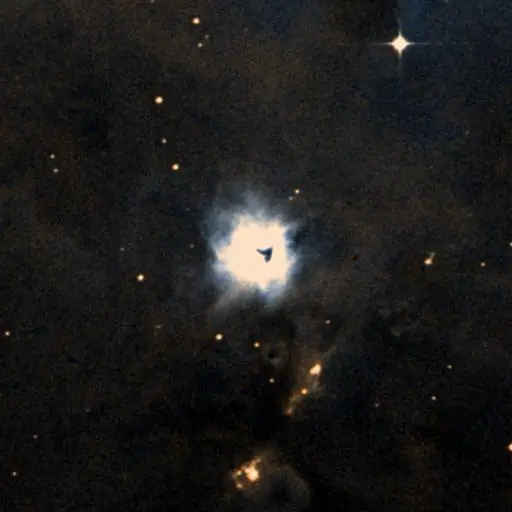
A glowing cloud with a black keyhole in it — and the keyhole turned out to be a real hole.
The young variable star V380 Orionis lights up NGC 1999, a reflection nebula in Orion with a strange black patch in the middle. For years astronomers took the patch for a dark nebula, a dense knot of dust blocking the light behind it. Then in 2009 the Herschel Space Observatory looked with infrared eyes that can see into such clouds — and still saw black. Follow-up observations confirmed it: the ‘Cosmic Keyhole’ is not dense dust at all but genuinely empty space.
NGC 1999 is 1,500 light-years away: the light we see from it set off around AD 530, around the time the Hagia Sophia was completed in Constantinople.
Did you know?
- Who punched the hole?. The leading idea is that narrow jets of gas from young stars in the region blasted through the sheet of dust and gas, perhaps helped by powerful radiation from a nearby mature star.
- Next door to a first. Close by lies HH 1/2, the first Herbig–Haro object ever recognised — a glowing knot where a jet from a newborn star slams into the gas around it.
How big is it?
918 Solar Systems side by side. Light itself takes 10 months to cross it. Shrink our Solar System — the Sun and all eight planets — to the size of a coin, and NGC 1999 would be 22 m across (about the length of a tennis court); the nearest star would be a football pitch away, and the Milky Way 2,520 km across.
A 9.5-magnitude (B-band) reflection nebula in Orion, about 2′ across.
When and where to see it
It is best placed in the evening sky around January, when it crosses the meridian at about 10 pm local time (around midnight in December). It can be seen from everywhere south of 83°N and never sets south of 83°S.
At its highest it stands 33° up from 50°N, 48° up from 35°N, 83° up from the equator, 62° up from 35°S.
Facts
- Type
- Reflection nebula
- Constellation
- Orion
- Designations
- NGC 1999
- Magnitude
- 9.5 (blue)
- Apparent size
- 2.0′ × 2.0′
- Position
- RA 5h 36.4m, Dec −6° 43′ (J2000)
- Distance
- 1,500 light-years
- Discovered
- William Herschel, 1785
Open AstroPilot to see when NGC 1999 is highest tonight from your location, how easy it is with your telescope or binoculars, and an eyepiece view.