Upper Sword (NGC 1981)
Upper Sword (NGC 1981) is a cluster + nebula in the constellation Orion, magnitude 4.2, 9.0′ across.
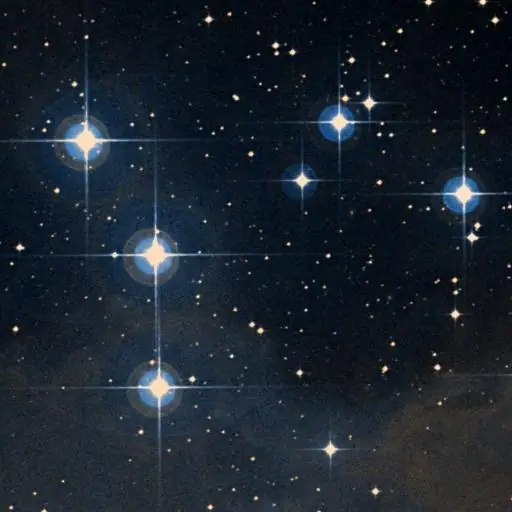
A loose ‘crocodile’ of stars at the top of Orion’s Sword, catalogued not by William Herschel but by his son.
Some see a crocodile here: one star for the snout, another for the tail, and two little rows of three stars for its legs. NGC 1981 is a loose open cluster at the northern end of Orion’s Sword, separated from the Orion Nebula by the dusty Running Man region. Bright as it is, it was not William Herschel but his son John who first catalogued it, on 4 January 1827.
Upper Sword (NGC 1981) is 1,200 light-years away: the light we see from it set off around AD 830, around the time Charlemagne was crowned emperor.
How big is it?
3,300 Solar Systems side by side. Light itself takes 3.1 years to cross it. Shrink our Solar System — the Sun and all eight planets — to the size of a coin, and Upper Sword would be 79.3 m across (about the length of a football pitch); the nearest star would be a football pitch away, and the Milky Way 2,520 km across.
A star cluster with nebulosity in Orion, about 9′ across. Its catalogued magnitude, 4.2, is that of the star cluster; the nebulosity is much fainter.
When and where to see it
It is best placed in the evening sky around January, when it crosses the meridian at about 10 pm local time (around midnight in December). It can be seen from everywhere south of 86°N and never sets south of 86°S.
At its highest it stands 36° up from 50°N, 51° up from 35°N, 86° up from the equator, 59° up from 35°S.
Facts
- Type
- Cluster + nebula
- Constellation
- Orion
- Designations
- NGC 1981
- Magnitude
- 4.2
- Apparent size
- 9.0′
- Position
- RA 5h 35.2m, Dec −4° 25′ (J2000)
- Distance
- 1,200 light-years
- Discovered
- John Herschel, 1827
Open AstroPilot to see when Upper Sword (NGC 1981) is highest tonight from your location, how easy it is with your telescope or binoculars, and an eyepiece view.