NGC 1973
NGC 1973 is a reflection nebula in the constellation Orion, magnitude 7.0 (blue), 5.0′ × 5.0′ across.
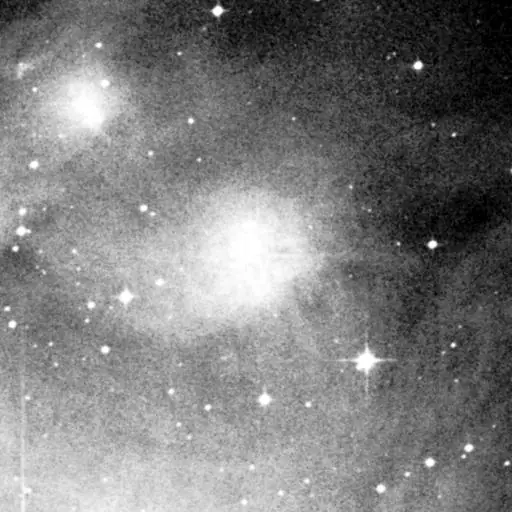
A small patch of dusty light at the northern end of Orion’s Sword, first noticed in 1862.
Just north of the Orion Nebula, at the top of Orion’s Sword, lies a softer glow nicknamed the Running Man. NGC 1973 is one of its three catalogued pieces: a reflection nebula, dust that shines because it scatters the light of hot young stars nearby, chiefly 42 Orionis. William Herschel had already seen the brightest part of the cloud, but this smaller patch was first noted by the German astronomer Heinrich d’Arrest in 1862.
NGC 1973 is 1,400 light-years away: the light we see from it set off around AD 630, 90 years after the Hagia Sophia was completed in Constantinople.
How big is it?
2,140 Solar Systems side by side. Light itself takes 2 years to cross it. Shrink our Solar System — the Sun and all eight planets — to the size of a coin, and NGC 1973 would be 51.4 m across (about the length of an Olympic pool); the nearest star would be a football pitch away, and the Milky Way 2,520 km across.
A 7.0-magnitude (B-band) reflection nebula in Orion, about 5′ across.
When and where to see it
It is best placed in the evening sky around January, when it crosses the meridian at about 10 pm local time (around midnight in December). It can be seen from everywhere south of 85°N and never sets south of 85°S.
At its highest it stands 35° up from 50°N, 50° up from 35°N, 85° up from the equator, 60° up from 35°S.
Facts
- Type
- Reflection nebula
- Constellation
- Orion
- Designations
- NGC 1973
- Magnitude
- 7.0 (blue)
- Apparent size
- 5.0′ × 5.0′
- Position
- RA 5h 35.1m, Dec −4° 44′ (J2000)
- Distance
- 1,400 light-years
- Discovered
- Heinrich d’Arrest, 1862
Open AstroPilot to see when NGC 1973 is highest tonight from your location, how easy it is with your telescope or binoculars, and an eyepiece view.