NGC 1893
NGC 1893 is an open cluster in the constellation Auriga, magnitude 7.5, 6.0′ across.
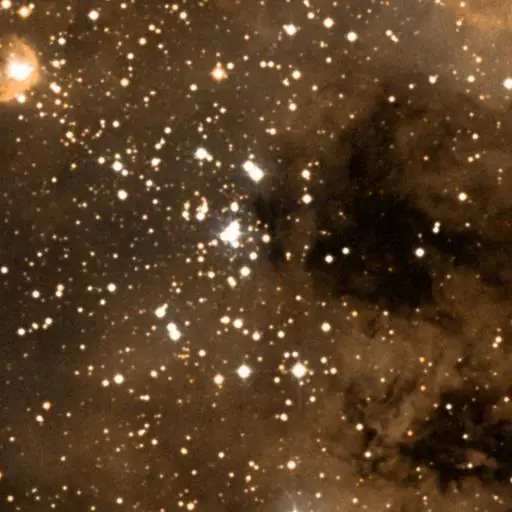
Thousands of newborn stars still inside the cloud that made them — the cluster at the heart of the Tadpole Nebula.
Inside the glowing emission nebula IC 410, nicknamed the Tadpole Nebula, a crowd of infant stars is still taking shape. NGC 1893 is that cluster, and the gas around it is the raw material it formed from. X-ray images from NASA’s Chandra observatory suggest the region holds about 4,600 young stellar objects — stars so new that most have not yet settled into the long, steady middle age our Sun is enjoying.
NGC 1893 is 9,300 light-years away: the light we see from it set off around 7280 BC, 1,770 years before the first towns were growing in the Fertile Crescent.
Did you know?
- The nebula nobody saw. John Herschel logged only a rich, coarse scatter of stars here in 1827. The glowing cloud around them was found in 1892, when Max Wolf photographed the field, and it was catalogued separately as IC 410.
How big is it?
Born about 4.4 million years ago, when our ancestors and the chimpanzees' were going their separate ways. Light itself takes 16 years to cross it. Gaia has picked out 207 stars moving together through space as its members. That’s 3.8 times the distance from the Sun to the nearest star. Shrink our Solar System — the Sun and all eight planets — to the size of a coin, and NGC 1893 would be 410 m across (4 football pitches end to end); the nearest star would be a football pitch away, and the Milky Way 2,520 km across.
A 7.5-magnitude open cluster in Auriga, about 6′ across.
When and where to see it
It is best placed in the evening sky around January, when it crosses the meridian at about 10 pm local time (around midnight in December). It can be seen from everywhere north of 57°S and never sets north of 57°N.
At its highest it stands 73° up from 50°N, 88° up from 35°N, 57° up from the equator, 22° up from 35°S.
Facts
- Type
- Open cluster
- Constellation
- Auriga
- Designations
- NGC 1893
- Magnitude
- 7.5
- Apparent size
- 6.0′
- Position
- RA 5h 22.7m, Dec +33° 25′ (J2000)
- Distance
- 9,300 light-years
- Discovered
- John Herschel, 1827
Open AstroPilot to see when NGC 1893 is highest tonight from your location, how easy it is with your telescope or binoculars, and an eyepiece view.