Polarissima Cluster (NGC 188)
Polarissima Cluster (NGC 188) is an open cluster in the constellation Cepheus, magnitude 8.1, 18′ across.
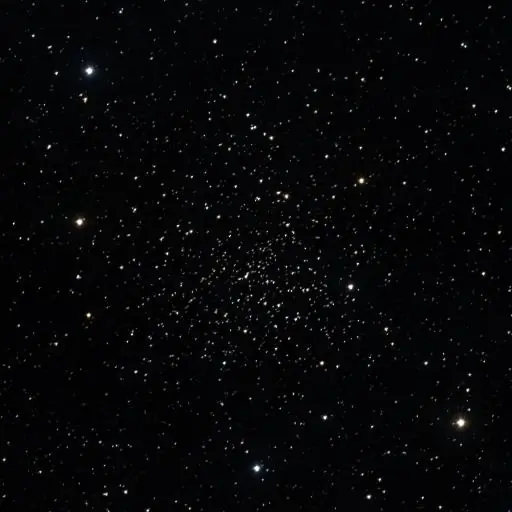
A family of stars that should have scattered long ago — and was already ancient when the Sun was born.
Most open clusters do not last. The gravity of the Milky Way tugs at their stars, and they drift apart and scatter long before they grow old. NGC 188 is a survivor. It lies above the plane of the galaxy, farther from the galactic centre than the Sun, and it has held together for billions of years.
John Herschel discovered it in the 19th century. Because it sits so close to the north celestial pole, it is nicknamed the Polarissima Cluster — ‘the most polar’ — and it heads Patrick Moore’s Caldwell catalogue as Caldwell 1.
Polarissima Cluster (NGC 188) is 5,900 light-years away: the light we see from it set off around 3880 BC, 670 years before writing was invented in Mesopotamia.
Did you know?
- Older than the Sun. At around 6.8 billion years old, the stars of NGC 188 had already been shining for some two billion years when the Sun and Earth formed.
- First on the list. Patrick Moore numbered the 109 objects of his Caldwell catalogue from north to south. NGC 188, the closest to the north celestial pole, became number 1.
How big is it?
Born about 7.1 billion years ago, when there were no animals on Earth at all. Light itself takes 30 years to cross it. Gaia has picked out 1,338 stars moving together through space as its members. That’s 7.2 times the distance from the Sun to the nearest star. Shrink our Solar System — the Sun and all eight planets — to the size of a coin, and the Polarissima Cluster would be 767 m across (7 football pitches end to end); the nearest star would be a football pitch away, and the Milky Way 2,520 km across.
One of the oldest open clusters known, about 7 billion years old, less than 5° from the north celestial pole; small telescopes show a faint, rich haze of stars.
When and where to see it
It is best placed in the evening sky around November, when it crosses the meridian at about 10 pm local time (around midnight in October). It can be seen from everywhere north of 5°S and never sets north of 5°N.
At its highest it stands 55° up from 50°N, 40° up from 35°N, 5° up from the equator, below the horizon from 35°S.
Facts
- Type
- Open cluster
- Constellation
- Cepheus
- Designations
- NGC 188, C 1, Mel 2, Cr 6, Melotte 2, Collinder 6
- Magnitude
- 8.1
- Apparent size
- 18′
- Position
- RA 0h 47.5m, Dec +85° 16′ (J2000)
- Distance
- 5,900 light-years
- Discovered
- John Herschel
Open AstroPilot to see when Polarissima Cluster (NGC 188) is highest tonight from your location, how easy it is with your telescope or binoculars, and an eyepiece view.