NGC 185
NGC 185 is a galaxy in the constellation Cassiopeia, magnitude 9.2, 13′ × 11′ across.
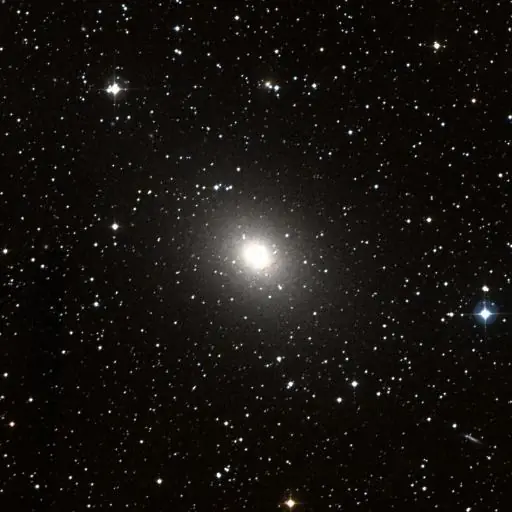
A small companion of the Andromeda Galaxy — and possibly the closest Seyfert galaxy to Earth.
William Herschel discovered this little galaxy on 30 November 1787 and logged it as H II.707. His son John observed it again in 1833 and listed it in his General Catalogue of 1864. Between 1898 and 1900 James Keeler took its first photographs, with the Crossley Reflector at Lick Observatory.
NGC 185 is a dwarf galaxy orbiting the Andromeda Galaxy, and it bends the rules for its kind. Most of its stars formed early on, yet it kept making new ones at a slow trickle until the recent past, in its central regions. In 1951 Walter Baade spotted young blue objects in it, which turned out to be star clusters.
NGC 185 is 2 million light-years away: the light we see from it set off about 2 million years ago, when our distant ancestors were making the first stone tools.
Did you know?
- A small but active heart. NGC 185 has an active nucleus usually classed as a Seyfert, though that status is questioned. If it holds, it is possibly the nearest Seyfert galaxy to Earth and the only one in the Local Group.
- Echo of an explosion. A supernova remnant has been found near the centre of NGC 185 — the debris of a star that exploded in this small, quiet galaxy.
How big is it?
A dwarf beside the Milky Way. Light itself takes 7,530 years to cross it. Shrink it to the length of a football pitch and our whole Solar System would be about the size of a red blood cell.
A dwarf elliptical satellite of the Andromeda Galaxy, brighter and more compact than nearby NGC 147.
When and where to see it
It is best placed in the evening sky around November, when it crosses the meridian at about 10 pm local time (around midnight in October). It can be seen from everywhere north of 42°S and never sets north of 42°N.
At its highest it stands 88° up from 50°N, 77° up from 35°N, 42° up from the equator, 7° up from 35°S.
Facts
- Type
- Galaxy
- Constellation
- Cassiopeia
- Designations
- C 18
- Magnitude
- 9.2
- Apparent size
- 13′ × 11′
- Position
- RA 0h 39.0m, Dec +48° 20′ (J2000)
- Distance
- 2 million light-years
- Discovered
- William Herschel, 1787
Open AstroPilot to see when NGC 185 is highest tonight from your location, how easy it is with your telescope or binoculars, and an eyepiece view.