NGC 1848
NGC 1848 is an open cluster in the constellation Mensa, magnitude 9.7, 2.2′ × 2.0′ across.
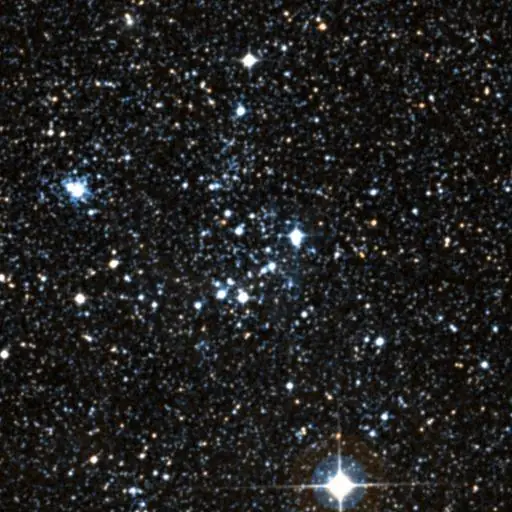
A cluster of the Large Magellanic Cloud in Mensa — the table beneath the Cape clouds.
A table beneath the clouds — that is the idea behind Mensa, the faintest of all constellations. Nicolas-Louis de Lacaille drew it in the 18th century in honour of Table Mountain above Cape Town, near where he observed. The Magellanic Clouds were sometimes called the Cape clouds, and Table Mountain is often capped by cloud, so he set a table in the sky beneath them. NGC 1848 is a star cluster in the part of the Large Magellanic Cloud that spills over into Mensa.
NGC 1848 is 160,000 light-years away: the light we see from it set off about 160,000 years ago, when our species still lived mostly in Africa.
How big is it?
24 times the distance from the Sun to the nearest star. Light itself takes 102 years to cross it. Shrink our Solar System — the Sun and all eight planets — to the size of a coin, and NGC 1848 would be 2.58 km across (a 30-minute walk); the nearest star would be a football pitch away, and the Milky Way 2,520 km across.
A 9.7-magnitude open cluster in Mensa, about 2.2′ × 2′.
When and where to see it
It is best placed in the evening sky around January, when it crosses the meridian at about 10 pm local time (around midnight in December). It can be seen from everywhere south of 19°N and never sets south of 19°S.
At its highest it stands below the horizon from 50°N, below the horizon from 35°N, 19° up from the equator, 54° up from 35°S.
Facts
- Type
- Open cluster
- Constellation
- Mensa
- Designations
- NGC 1848
- Magnitude
- 9.7
- Apparent size
- 2.2′ × 2.0′
- Position
- RA 5h 7.5m, Dec −71° 12′ (J2000)
- Distance
- 160,000 light-years
- Discovered
- Nicolas Louis de Lacaille, 1760
Open AstroPilot to see when NGC 1848 is highest tonight from your location, how easy it is with your telescope or binoculars, and an eyepiece view.