NGC 1808
NGC 1808 is a galaxy in the constellation Columba, magnitude 10.2, 5.4′ × 1.8′ across.
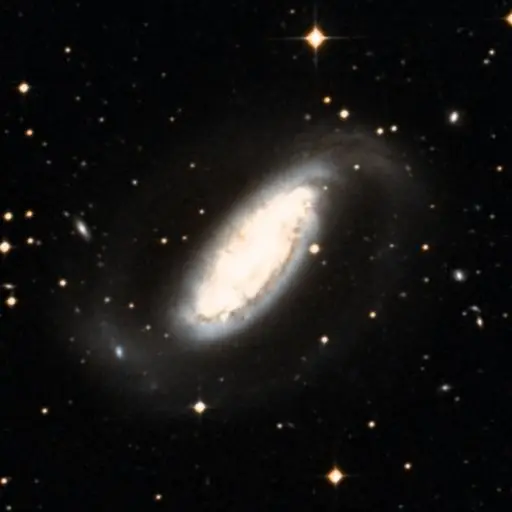
A spiral galaxy with a ring of ‘hot spots’ around a furiously star-forming core.
A ring of “hot spots” circles the core of NGC 1808: young star clusters and the remains of exploded stars. The centre was once suspected of being a Seyfert nucleus, powered by a feeding black hole, but most of its energy now seems to come from a burst of star birth, with perhaps a weak active nucleus as well. Gas blowing out of the centre has formed prominent dust lanes.
This spiral galaxy has a warped disc and may have had a distant encounter with its neighbour NGC 1792. James Dunlop discovered it on 10 May 1826, noting a “faint nebula”.
NGC 1808 is 32 million light-years away: the light we see from it set off about 32 million years ago, when the Himalayas and the Alps were rising.
How big is it?
50% of the Milky Way’s width. Light itself takes 50,000 years to cross it. Shrink it to the length of a football pitch and our whole Solar System would be smaller than a bacterium.
A 10.2-magnitude spiral galaxy (Sa) in Columba, about 5.4′ × 1.8′.
When and where to see it
It is best placed in the evening sky around January, when it crosses the meridian at about 10 pm local time (around midnight in December). It can be seen from everywhere south of 52°N and never sets south of 52°S.
At its highest it stands 2° up from 50°N, 17° up from 35°N, 52° up from the equator, 87° up from 35°S.
Facts
- Type
- Galaxy
- Constellation
- Columba
- Designations
- NGC 1808
- Magnitude
- 10.2
- Apparent size
- 5.4′ × 1.8′
- Position
- RA 5h 7.7m, Dec −37° 31′ (J2000)
- Distance
- 32 million light-years
- Discovered
- James Dunlop, 1826
Open AstroPilot to see when NGC 1808 is highest tonight from your location, how easy it is with your telescope or binoculars, and an eyepiece view.