NGC 1792
NGC 1792 is a galaxy in the constellation Columba, magnitude 10.2, 5.5′ × 2.8′ across.
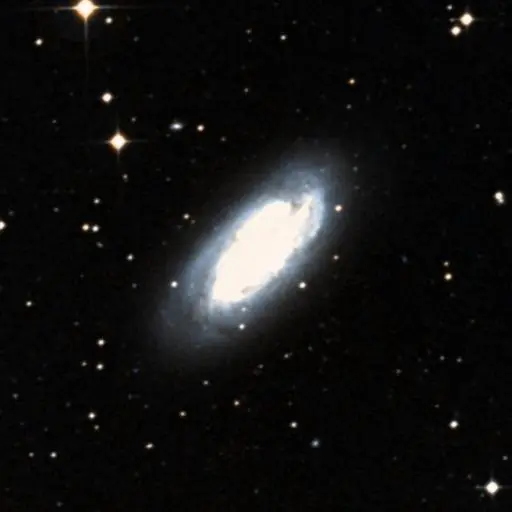
A spiral galaxy making stars at several times the Milky Way’s rate.
Every year NGC 1792 turns about 11 Suns’ worth of gas into new stars — several times the Milky Way’s rate — and its arms are dotted with glowing star-forming regions. This flocculent spiral galaxy has patchy, broken arms and no central bulge to speak of. Its neighbour NGC 1808 is unusually busy too, which hints that a distant encounter between the two stirred them up. The lopsided spread of hydrogen gas in NGC 1792 backs that up.
James Dunlop discovered it on 4 October 1826.
NGC 1792 is 34 million light-years away: the light we see from it set off about 34 million years ago, when the Himalayas and the Alps were rising.
How big is it?
55% of the Milky Way’s width. Light itself takes 55,000 years to cross it. Shrink it to the length of a football pitch and our whole Solar System would be smaller than a bacterium. All told — stars, gas and dark matter — it weighs about 54 billion Suns.
A 10.2-magnitude spiral galaxy (Sbc) in Columba, about 5.5′ × 2.8′.
When and where to see it
It is best placed in the evening sky around January, when it crosses the meridian at about 10 pm local time (around midnight in December). It can be seen from everywhere south of 52°N and never sets south of 52°S.
At its highest it stands 2° up from 50°N, 17° up from 35°N, 52° up from the equator, 87° up from 35°S.
Facts
- Type
- Galaxy
- Constellation
- Columba
- Designations
- NGC 1792
- Magnitude
- 10.2
- Apparent size
- 5.5′ × 2.8′
- Position
- RA 5h 5.2m, Dec −37° 59′ (J2000)
- Distance
- 34 million light-years
- Discovered
- James Dunlop, 1826
Open AstroPilot to see when NGC 1792 is highest tonight from your location, how easy it is with your telescope or binoculars, and an eyepiece view.