NGC 1788
NGC 1788 is a reflection nebula in the constellation Orion, magnitude 5.8 (blue), 2.0′ × 2.0′ across.
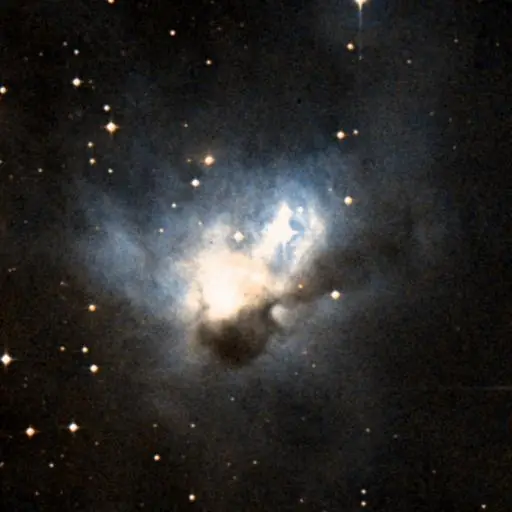
A small reflection nebula in Orion, sharply cut off by a dark cloud.
Light and dark meet at NGC 1788. This reflection nebula in Orion glows with starlight scattered by dust, but on its south-western side it ends abruptly against a dark nebula, LDN 1616. The dark cloud seems to be part of the same structure: the same dust, lit on one side and in shadow on the other. William Herschel discovered it in 1786.
NGC 1788 is 1,300 light-years away: the light we see from it set off around AD 730, 75 years before Charlemagne was crowned emperor.
How big is it?
795 Solar Systems side by side. Light itself takes 9 months to cross it. Shrink our Solar System — the Sun and all eight planets — to the size of a coin, and NGC 1788 would be 19.1 m across (about the length of a tennis court); the nearest star would be a football pitch away, and the Milky Way 2,520 km across.
A 5.8-magnitude (B-band) reflection nebula in Orion, about 2′ across.
When and where to see it
It is best placed in the evening sky around January, when it crosses the meridian at about 10 pm local time (around midnight in December). It can be seen from everywhere south of 87°N and never sets south of 87°S.
At its highest it stands 37° up from 50°N, 52° up from 35°N, 87° up from the equator, 58° up from 35°S.
Facts
- Type
- Reflection nebula
- Constellation
- Orion
- Designations
- NGC 1788
- Magnitude
- 5.8 (blue)
- Apparent size
- 2.0′ × 2.0′
- Position
- RA 5h 6.9m, Dec −3° 20′ (J2000)
- Distance
- 1,300 light-years
- Discovered
- William Herschel, 1786
Open AstroPilot to see when NGC 1788 is highest tonight from your location, how easy it is with your telescope or binoculars, and an eyepiece view.