NGC 1566
NGC 1566 is a galaxy in the constellation Dorado, magnitude 9.7, 7.2′ × 5.0′ across.
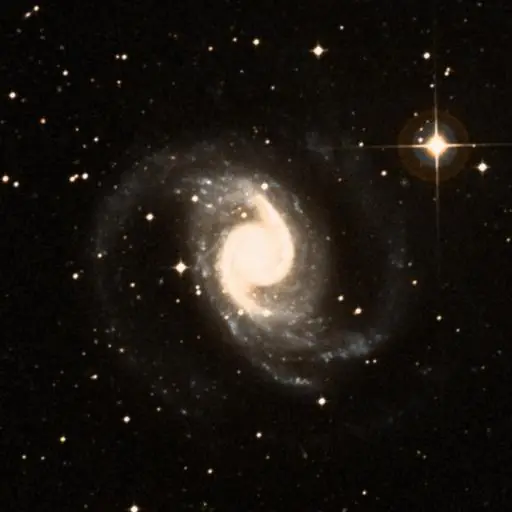
The Spanish Dancer: a sweeping spiral with a restless black hole at its heart.
Its strong, symmetrical arms earned NGC 1566 the nickname Spanish Dancer. At its centre lies one of the closest and brightest Seyfert nuclei — an active core where gas spirals into a black hole of about 13 million Suns. It is also the nearest known “changing-look” galaxy: a type whose active core can flare up or fade dramatically within a few years.
This spiral galaxy leads its own subgroup within the Dorado Group. James Dunlop discovered it on 28 May 1826.
NGC 1566 is 58 million light-years away: the light we see from it set off about 58 million years ago, when mammals were taking over a world without dinosaurs.
Did you know?
- Brightest of 2021. Supernova SN 2021aefx, found in NGC 1566 in November 2021, reached magnitude 12 — the brightest supernova of that year.
How big is it?
1.2 times as wide as our Milky Way. Light itself takes 120,000 years to cross it. Shrink it to the length of a football pitch and our whole Solar System would be smaller than a bacterium. All told — stars, gas and dark matter — it weighs about 65 billion Suns.
A 9.7-magnitude weakly barred spiral galaxy (SABb) in Dorado, about 7.2′ × 5′.
When and where to see it
It is best placed in the evening sky around December, when it crosses the meridian at about 10 pm local time (around midnight in November). It can be seen from everywhere south of 35°N and never sets south of 35°S.
At its highest it stands below the horizon from 50°N, 0° up from 35°N, 35° up from the equator, 70° up from 35°S.
Facts
- Type
- Galaxy
- Constellation
- Dorado
- Designations
- NGC 1566
- Magnitude
- 9.7
- Apparent size
- 7.2′ × 5.0′
- Position
- RA 4h 20.0m, Dec −54° 56′ (J2000)
- Distance
- 58 million light-years
- Discovered
- James Dunlop, 1826
Open AstroPilot to see when NGC 1566 is highest tonight from your location, how easy it is with your telescope or binoculars, and an eyepiece view.