Hind's Variable Nebula (NGC 1555)
Hind's Variable Nebula (NGC 1555) is a reflection nebula in the constellation Taurus, magnitude 10.0 (blue), 1.8′ × 1.4′ across.
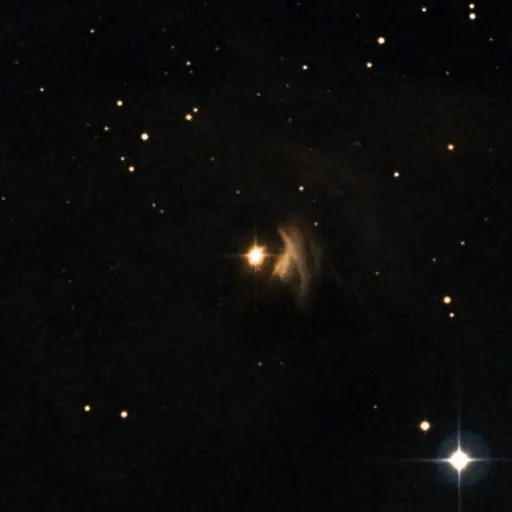
Hind’s Variable Nebula: a cloud that brightens and fades with the young star T Tauri.
Most nebulae look the same for centuries. Hind’s Variable Nebula does not. John Russell Hind discovered it on 11 October 1852, and since then it has brightened and faded as the light reaching it from its star changes. That star is T Tauri, a young variable star that gave its name to a whole class of newborn stars still settling down.
The nebula is also a Herbig–Haro object: the kind of glowing patch made where gas blown out by a young star strikes the cloud around it.
Hind's Variable Nebula (NGC 1555) is 470 light-years away: the light we see from it set off around 1555, around the time Copernicus put the Sun at the centre of the Solar System.
How big is it?
262 Solar Systems side by side. Light itself takes 3 months to cross it. Shrink our Solar System — the Sun and all eight planets — to the size of a coin, and Hind's Variable Nebula would be 6.3 m across (about the length of a car); the nearest star would be a football pitch away, and the Milky Way 2,520 km across.
A 10.0-magnitude (B-band) reflection nebula in Taurus, about 1.8′ × 1.4′.
When and where to see it
It is best placed in the evening sky around December, when it crosses the meridian at about 10 pm local time (around midnight in November). It can be seen from everywhere north of 70°S and never sets north of 70°N.
At its highest it stands 60° up from 50°N, 75° up from 35°N, 70° up from the equator, 35° up from 35°S.
Facts
- Type
- Reflection nebula
- Constellation
- Taurus
- Designations
- NGC 1555, Hind's Nebula
- Magnitude
- 10.0 (blue)
- Apparent size
- 1.8′ × 1.4′
- Position
- RA 4h 22.0m, Dec +19° 32′ (J2000)
- Distance
- 470 light-years
- Discovered
- John Russell Hind, 1852
Open AstroPilot to see when Hind's Variable Nebula (NGC 1555) is highest tonight from your location, how easy it is with your telescope or binoculars, and an eyepiece view.