NGC 1553
NGC 1553 is a galaxy in the constellation Dorado, magnitude 9.3, 6.3′ × 4.3′ across.
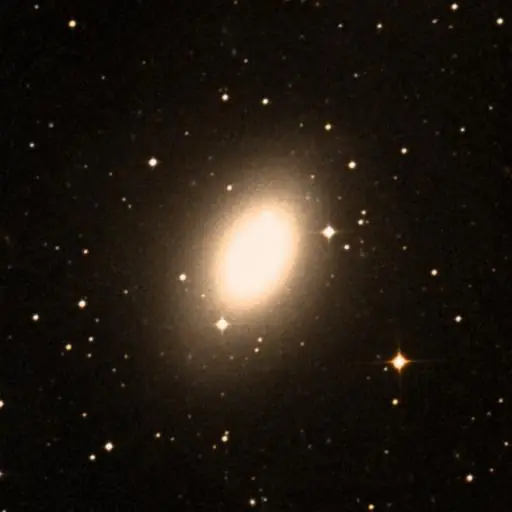
A textbook lenticular galaxy hiding a spiral that only X-ray eyes can see.
Astronomers treat NGC 1553 as a prototype lenticular galaxy, complete with an especially well-developed “lens”: a zone of nearly even brightness between its central bulge and outer disc. Yet X-ray images from Chandra reveal something hidden: a roughly symmetrical spiral in its hot gas, invisible in ordinary light, matched by a spiral pattern in glowing hydrogen.
John Herschel discovered it on 5 December 1834 with an 18.7-inch reflector. It is the second-brightest galaxy in the Dorado Group, paired with NGC 1549.
NGC 1553 is 60 million light-years away: the light we see from it set off about 60 million years ago, when mammals were taking over a world without dinosaurs.
Did you know?
- Dead stars in old clusters. Chandra also found many point-like X-ray sources: neutron stars and black holes pulling gas off companion stars. Most lie in globular clusters, relics of the galaxy’s busy past.
How big is it?
About as wide as our Milky Way. Light itself takes 110,000 years to cross it. Shrink it to the length of a football pitch and our whole Solar System would be smaller than a bacterium.
A 9.3-magnitude lenticular galaxy (S0) in Dorado, about 6.3′ × 4.3′.
When and where to see it
It is best placed in the evening sky around December, when it crosses the meridian at about 10 pm local time (around midnight in November). It can be seen from everywhere south of 34°N and never sets south of 34°S.
At its highest it stands below the horizon from 50°N, below the horizon from 35°N, 34° up from the equator, 69° up from 35°S.
Facts
- Type
- Galaxy
- Constellation
- Dorado
- Designations
- NGC 1553
- Magnitude
- 9.3
- Apparent size
- 6.3′ × 4.3′
- Position
- RA 4h 16.2m, Dec −55° 47′ (J2000)
- Distance
- 60 million light-years
- Discovered
- John Herschel, 1834
Open AstroPilot to see when NGC 1553 is highest tonight from your location, how easy it is with your telescope or binoculars, and an eyepiece view.