NGC 1549
NGC 1549 is a galaxy in the constellation Dorado, magnitude 9.8, 5.1′ × 4.3′ across.
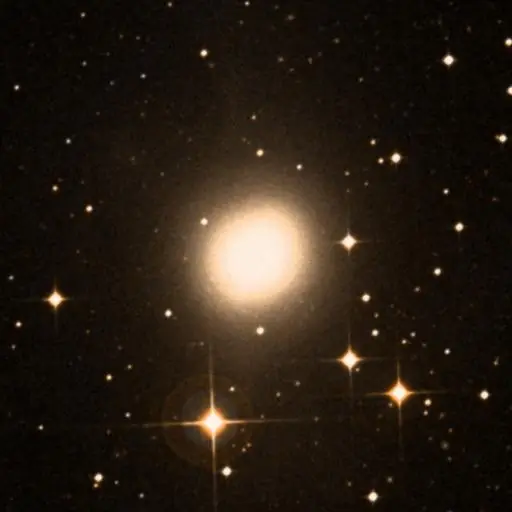
The largest elliptical of the Dorado Group, just beginning to tangle with its neighbour.
NGC 1549 and NGC 1553 sit together at the centre of the Dorado Group, and they have begun to interact. The outer contours of NGC 1549 are twisted, and faint shells of stars surround it — signs of disturbance. It is the group’s largest elliptical galaxy, yet oddly short of globular clusters, with only about 150, few for a galaxy its size. The Spitzer Space Telescope found none of the usual infrared signature of interstellar dust.
John Herschel discovered it on 6 December 1835, though James Dunlop may have seen it in 1826.
NGC 1549 is 64 million light-years away: the light we see from it set off about 64 million years ago, when mammals were taking over a world without dinosaurs.
How big is it?
About as wide as our Milky Way. Light itself takes 95,000 years to cross it. Shrink it to the length of a football pitch and our whole Solar System would be smaller than a bacterium.
A 9.8-magnitude elliptical galaxy (E) in Dorado, about 5.1′ × 4.4′.
When and where to see it
It is best placed in the evening sky around December, when it crosses the meridian at about 10 pm local time (around midnight in November). It can be seen from everywhere south of 34°N and never sets south of 34°S.
At its highest it stands below the horizon from 50°N, below the horizon from 35°N, 34° up from the equator, 69° up from 35°S.
Facts
- Type
- Galaxy
- Constellation
- Dorado
- Designations
- NGC 1549
- Magnitude
- 9.8
- Apparent size
- 5.1′ × 4.3′
- Position
- RA 4h 15.8m, Dec −55° 36′ (J2000)
- Distance
- 64 million light-years
- Discovered
- John Herschel, 1835, James Dunlop may have seen it in 1826
Open AstroPilot to see when NGC 1549 is highest tonight from your location, how easy it is with your telescope or binoculars, and an eyepiece view.