NGC 1535
NGC 1535 is a planetary nebula in the constellation Eridanus, magnitude 9.6, 51″ across.
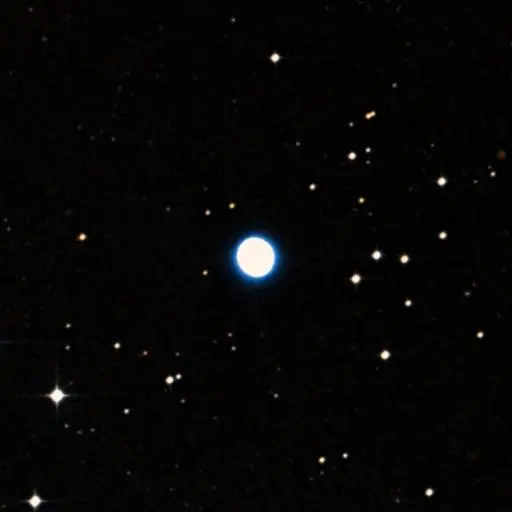
Cleopatra’s Eye: a southern cousin of the Eskimo Nebula, shaped by the wind of a fierce star.
Known as Cleopatra’s Eye, NGC 1535 looks remarkably like the Eskimo Nebula in Gemini, in both colour and structure. It is a planetary nebula: the cast-off outer layers of a dying star. That star, still at the centre, is now a hot O-type star of about 66,000 kelvin with a little over half the Sun’s mass, and its fast wind is thought to have shaped the nebula into its rounded form. The gas seems to have formed in a region poor in heavy elements.
William Herschel discovered it on 1 February 1785.
NGC 1535 is 4,200 light-years away: the light we see from it set off around 2180 BC, 390 years after the Great Pyramid of Giza was completed.
How big is it?
1,090 Solar Systems side by side. Light itself takes about a year to cross it. Shrink our Solar System — the Sun and all eight planets — to the size of a coin, and NGC 1535 would be 26.2 m across (about the length of a tennis court); the nearest star would be a football pitch away, and the Milky Way 2,520 km across.
A 9.6-magnitude planetary nebula in Eridanus, about 51″ across. Its central star is magnitude 12.2.
When and where to see it
It is best placed in the evening sky around December, when it crosses the meridian at about 10 pm local time (around midnight in November). It can be seen from everywhere south of 77°N and never sets south of 77°S.
At its highest it stands 27° up from 50°N, 42° up from 35°N, 77° up from the equator, 68° up from 35°S.
Facts
- Type
- Planetary nebula
- Constellation
- Eridanus
- Designations
- NGC 1535
- Magnitude
- 9.6
- Apparent size
- 51″
- Position
- RA 4h 14.3m, Dec −12° 44′ (J2000)
- Distance
- 4,200 light-years
- Discovered
- William Herschel, 1785
Open AstroPilot to see when NGC 1535 is highest tonight from your location, how easy it is with your telescope or binoculars, and an eyepiece view.