NGC 1532
NGC 1532 is a galaxy in the constellation Eridanus, magnitude 10.1, 11′ × 3.1′ across.
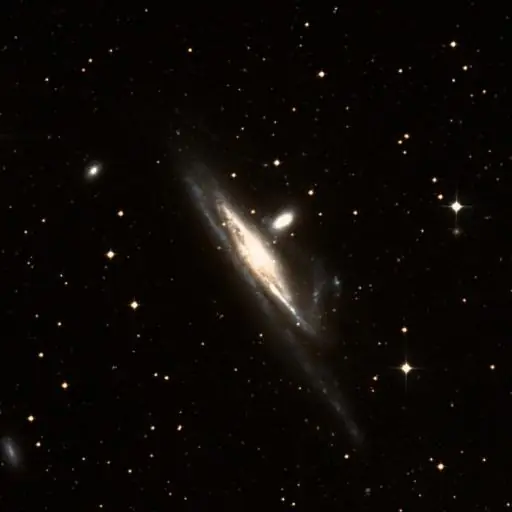
An edge-on spiral hiding a bar in its box-shaped bulge, tangled with a small companion.
We see NGC 1532 almost exactly side-on, and that hides something. Its central bulge has a boxy shape, a sign that it is really a bar seen from the side. Bars are easy to spot in galaxies seen face-on; in an edge-on galaxy like this one, it takes careful analysis to tell bar from bulge. Sometimes called Haley’s Coronet, this barred spiral galaxy is also tangled with a small companion, the dwarf galaxy NGC 1531, whose pull has raised unusual plumes above its disc.
James Dunlop discovered it on 29 October 1826.
NGC 1532 is 61 million light-years away: the light we see from it set off about 61 million years ago, when mammals were taking over a world without dinosaurs.
How big is it?
2 times as wide as our Milky Way. Light itself takes 200,000 years to cross it. Shrink it to the length of a football pitch and our whole Solar System would be smaller than a bacterium.
A 10.1-magnitude barred spiral galaxy (SBb) in Eridanus, about 11′ × 3.1′.
When and where to see it
It is best placed in the evening sky around December, when it crosses the meridian at about 10 pm local time (around midnight in November). It can be seen from everywhere south of 57°N and never sets south of 57°S.
At its highest it stands 7° up from 50°N, 22° up from 35°N, 57° up from the equator, 88° up from 35°S.
Facts
- Type
- Galaxy
- Constellation
- Eridanus
- Designations
- NGC 1532
- Magnitude
- 10.1
- Apparent size
- 11′ × 3.1′
- Position
- RA 4h 12.1m, Dec −32° 52′ (J2000)
- Distance
- 61 million light-years
- Discovered
- James Dunlop, 1826
Open AstroPilot to see when NGC 1532 is highest tonight from your location, how easy it is with your telescope or binoculars, and an eyepiece view.