NGC 1514
NGC 1514 is a planetary nebula in the constellation Taurus, magnitude 10.2, 2.2′ across.
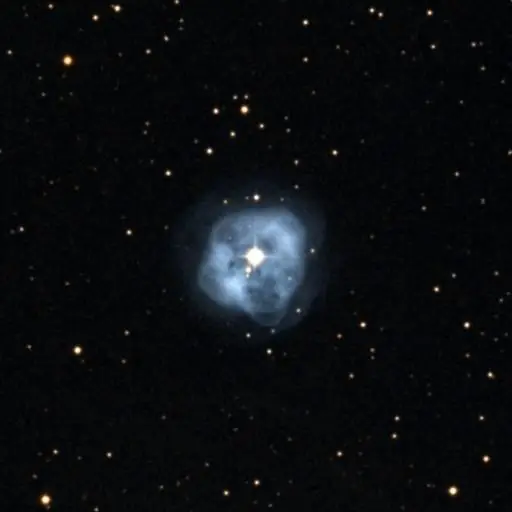
The Crystal Ball Nebula: the glowing shell that changed William Herschel’s mind about nebulae.
On 13 November 1790 William Herschel met “a most singular phenomenon”. Until then he believed every nebula was a mass of stars too distant to resolve. Here was a single star wrapped in a faint glow, and he concluded that the glow was “not of a starry nature”: some nebulae, at least, were made of something other than stars.
Today we know it as the Crystal Ball Nebula, a planetary nebula: gas thrown off by a dying star, one of a pair at its centre.
NGC 1514 is 1,500 light-years away: the light we see from it set off around AD 530, around the time the Hagia Sophia was completed in Constantinople.
Did you know?
- Hidden rings. In mid-infrared light a pair of faint rings appears, forming a diabolo shape. The James Webb Space Telescope has shown them to be clumpy and filamentary.
- A slow waltz. The two central stars were once thought to orbit every 10 days or so. Years of watching showed the true period is about 9 years — one of the longest known for any planetary nebula.
How big is it?
1,010 Solar Systems side by side. Light itself takes about a year to cross it. Shrink our Solar System — the Sun and all eight planets — to the size of a coin, and NGC 1514 would be 24.2 m across (about the length of a tennis court); the nearest star would be a football pitch away, and the Milky Way 2,520 km across.
A 10.2-magnitude planetary nebula in Taurus, about 2.2′ across. Its central star is magnitude 9.4.
When and where to see it
It is best placed in the evening sky around December, when it crosses the meridian at about 10 pm local time (around midnight in November). It can be seen from everywhere north of 59°S and never sets north of 59°N.
At its highest it stands 71° up from 50°N, 86° up from 35°N, 59° up from the equator, 24° up from 35°S.
Facts
- Type
- Planetary nebula
- Constellation
- Taurus
- Designations
- NGC 1514
- Magnitude
- 10.2
- Apparent size
- 2.2′
- Position
- RA 4h 9.3m, Dec +30° 47′ (J2000)
- Distance
- 1,500 light-years
- Discovered
- William Herschel, 1790
Open AstroPilot to see when NGC 1514 is highest tonight from your location, how easy it is with your telescope or binoculars, and an eyepiece view.