NGC 1502
NGC 1502 is an open cluster in the constellation Camelopardalis, magnitude 6.9, 10′ across.
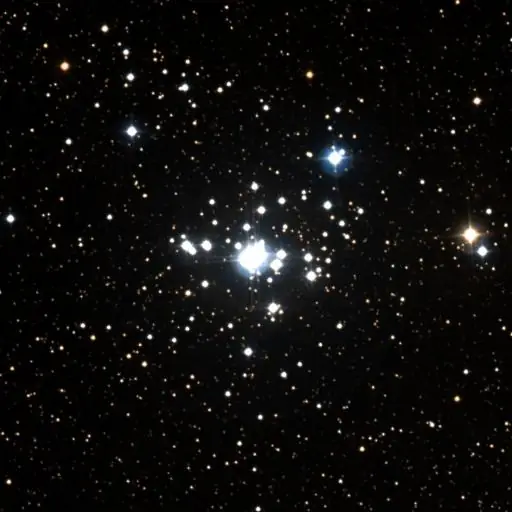
The Golden Harp Cluster, where Kemble’s Cascade seems to tumble to an end.
A long chain of stars, Kemble’s Cascade, seems to tumble across the sky and splash into NGC 1502. The meeting is a trick of perspective: the chain and the cluster are unrelated. The Cascade is named after the Canadian amateur astronomer Father Lucian Kemble.
NGC 1502, the Golden Harp Cluster, is a young open cluster of about 60 stars, between 5 and 15 million years old, on the outer edge of the Camelopardalis OB1 association. William Herschel discovered it on 3 November 1787.
NGC 1502 is 3,300 light-years away: the light we see from it set off around 1280 BC, around the time Tutankhamun was buried in the Valley of the Kings.
Did you know?
- A nest of variables. At least eleven of its stars vary in brightness. One, SZ Camelopardalis, is an eclipsing binary that is itself part of a visual double star.
How big is it?
Born about 10 million years ago, when great apes were spreading through Africa and Europe. Light itself takes 9.8 years to cross it. Gaia has picked out 383 stars moving together through space as its members. That’s 2.3 times the distance from the Sun to the nearest star. Shrink our Solar System — the Sun and all eight planets — to the size of a coin, and NGC 1502 would be 247 m across (2 football pitches end to end); the nearest star would be a football pitch away, and the Milky Way 2,520 km across.
A 6.9-magnitude open cluster in Camelopardalis, about 10′ across.
When and where to see it
It is best placed in the evening sky around December, when it crosses the meridian at about 10 pm local time (around midnight in November). It can be seen from everywhere north of 28°S and never sets north of 28°N.
At its highest it stands 78° up from 50°N, 63° up from 35°N, 28° up from the equator, below the horizon from 35°S.
Facts
- Type
- Open cluster
- Constellation
- Camelopardalis
- Designations
- NGC 1502
- Magnitude
- 6.9
- Apparent size
- 10′
- Position
- RA 4h 7.8m, Dec +62° 20′ (J2000)
- Distance
- 3,300 light-years
- Discovered
- William Herschel, 1787
Open AstroPilot to see when NGC 1502 is highest tonight from your location, how easy it is with your telescope or binoculars, and an eyepiece view.