California Nebula (NGC 1499)
California Nebula (NGC 1499) is an emission nebula in the constellation Perseus, magnitude 5.0 (blue), 2.7° × 40′ across.
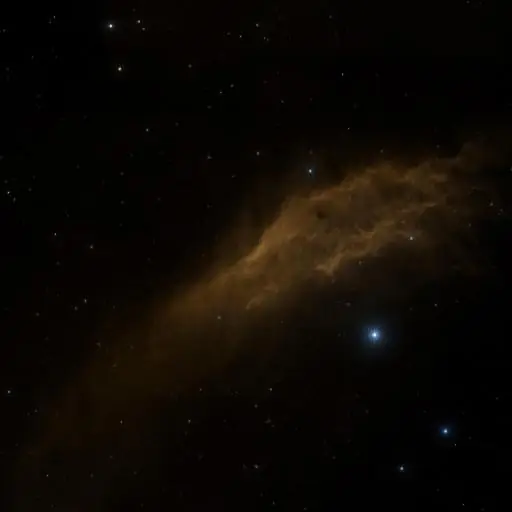
The California Nebula — which, by coincidence, passes straight over California.
Long-exposure photographs show the outline of a US state, and so this cloud became the California Nebula. By a neat coincidence, it also passes straight overhead as seen from central California, whose latitude matches the nebula’s position on the sky.
It is an emission nebula: hydrogen made to glow by the ultraviolet light of Xi Persei, or Menkib, a hot and very energetic O-type star nearby. E. E. Barnard discovered it in 1884.
California Nebula (NGC 1499) is 1,300 light-years away: the light we see from it set off around AD 730, 75 years before Charlemagne was crowned emperor.
Did you know?
- Galaxies behind the glow. The nebula overlaps the Perseus–Pisces Supercluster, so distant galaxies can be seen shining through it. The brightest is the elliptical galaxy IC 2005.
How big is it?
14 times the distance from the Sun to the nearest star. Light itself takes 61 years to cross it. Shrink our Solar System — the Sun and all eight planets — to the size of a coin, and the California Nebula would be 1.53 km across (a 20-minute walk); the nearest star would be a football pitch away, and the Milky Way 2,520 km across.
A 5.0-magnitude (B-band) emission nebula in Perseus, about 2.7° × 0.7°.
When and where to see it
It is best placed in the evening sky around December, when it crosses the meridian at about 10 pm local time (around midnight in November). It can be seen from everywhere north of 54°S and never sets north of 54°N.
At its highest it stands 76° up from 50°N, 89° up from 35°N, 54° up from the equator, 19° up from 35°S.
Facts
- Type
- Emission nebula
- Constellation
- Perseus
- Designations
- NGC 1499
- Magnitude
- 5.0 (blue)
- Apparent size
- 2.7° × 40′
- Position
- RA 4h 3.2m, Dec +36° 22′ (J2000)
- Distance
- 1,300 light-years
- Discovered
- E. E. Barnard, 1884
Open AstroPilot to see when California Nebula (NGC 1499) is highest tonight from your location, how easy it is with your telescope or binoculars, and an eyepiece view.