NGC 147 (C 17)
NGC 147 (C 17) is a galaxy in the constellation Cassiopeia, magnitude 9.7, 9.4′ × 5.4′ across.
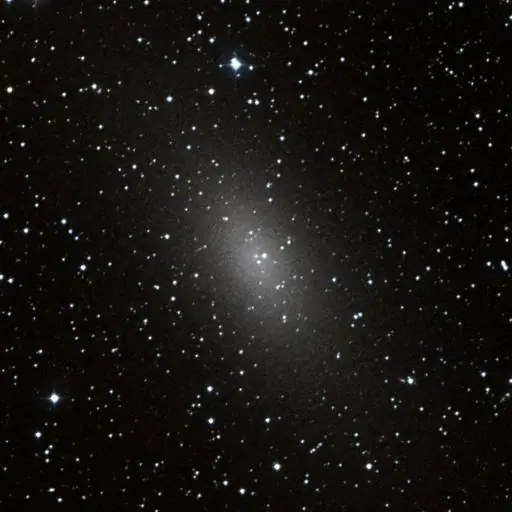
A faint companion of the Andromeda Galaxy that stopped making stars around three billion years ago.
John Herschel discovered this dim glow in Cassiopeia in September 1829. More than a century passed before anyone saw what it really was: in 1944 Walter Baade, using the 100-inch telescope at Mount Wilson, resolved it into individual stars and showed that it belongs to our own Local Group of galaxies.
NGC 147 is a dwarf spheroidal galaxy, one of the small satellites of the Andromeda Galaxy. Its last significant burst of star birth was about 3 billion years ago. Since then it has been running down: no hydrogen gas has been detected, far less than its ageing stars should have shed, so the galaxy seems to have lost the raw material for new stars.
NGC 147 (C 17) is 2.3 million light-years away: the light we see from it set off about 2.3 million years ago, when our distant ancestors were making the first stone tools.
Did you know?
- Travelling as a pair. NGC 147 and its neighbour NGC 185 form a physical pair: two remote satellites of the Andromeda Galaxy travelling together.
- Generations of stars. Its old stars vary in age and in their content of heavy elements, showing that NGC 147 enriched itself over several generations of stars before its gas disappeared.
How big is it?
A dwarf beside the Milky Way. Light itself takes 6,290 years to cross it. Shrink it to the length of a football pitch and our whole Solar System would be thinner than a human hair.
A dwarf spheroidal satellite of the Andromeda Galaxy; faint and diffuse, it needs dark skies and lies about 1° from its brighter sibling NGC 185.
When and where to see it
It is best placed in the evening sky around November, when it crosses the meridian at about 10 pm local time (around midnight in October). It can be seen from everywhere north of 41°S and never sets north of 41°N.
At its highest it stands 89° up from 50°N, 76° up from 35°N, 41° up from the equator, 6° up from 35°S.
Facts
- Type
- Galaxy
- Constellation
- Cassiopeia
- Designations
- C 17
- Magnitude
- 9.7
- Apparent size
- 9.4′ × 5.4′
- Position
- RA 0h 33.2m, Dec +48° 31′ (J2000)
- Distance
- 2.3 million light-years
- Discovered
- John Herschel, 1829
Open AstroPilot to see when NGC 147 (C 17) is highest tonight from your location, how easy it is with your telescope or binoculars, and an eyepiece view.