NGC 146 (Cr 5)
NGC 146 (Cr 5) is an open cluster in the constellation Cassiopeia, magnitude 9.1, 3.6′ across.
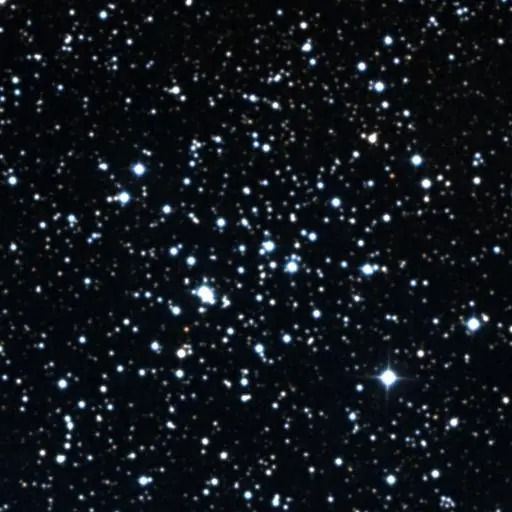
A young cluster in Cassiopeia where some stars are still newborns.
Some of the stars in NGC 146 have not yet grown up. This young open cluster is full of hot blue-white stars and pre-main-sequence stars — newborns still contracting, not yet shining steadily by fusing hydrogen. Among its heaviest members are two Herbig Be stars, massive youngsters still surrounded by discs of leftover gas and dust.
John Herschel discovered it in 1829 with the 18.7-inch reflecting telescope built by his father, William.
NGC 146 (Cr 5) is 9,000 light-years away: the light we see from it set off around 6980 BC, 1,470 years before the first towns were growing in the Fertile Crescent.
Did you know?
- A sibling cluster. Nearby lies the cluster King 14. The two follow similar orbits around the Milky Way, taking about 255 million years per lap, and probably formed in the same giant cloud of gas — though gravity no longer binds them together.
How big is it?
Born about 35 million years ago, when the Himalayas and the Alps were rising. Light itself takes 9.4 years to cross it. Gaia has picked out 68 stars moving together through space as its members. That’s 2.2 times the distance from the Sun to the nearest star. Shrink our Solar System — the Sun and all eight planets — to the size of a coin, and NGC 146 would be 238 m across (2 football pitches end to end); the nearest star would be a football pitch away, and the Milky Way 2,520 km across.
A 9.1-magnitude open cluster in Cassiopeia, about 3.6′ across.
When and where to see it
It is best placed in the evening sky around November, when it crosses the meridian at about 10 pm local time (around midnight in October). It can be seen from everywhere north of 27°S and never sets north of 27°N.
At its highest it stands 77° up from 50°N, 62° up from 35°N, 27° up from the equator, below the horizon from 35°S.
Facts
- Type
- Open cluster
- Constellation
- Cassiopeia
- Designations
- Cr 5, Collinder 5
- Magnitude
- 9.1
- Apparent size
- 3.6′
- Position
- RA 0h 33.1m, Dec +63° 19′ (J2000)
- Distance
- 9,000 light-years
- Discovered
- John Herschel, 1829
Open AstroPilot to see when NGC 146 (Cr 5) is highest tonight from your location, how easy it is with your telescope or binoculars, and an eyepiece view.