NGC 1444
NGC 1444 is an open cluster in the constellation Perseus, magnitude 6.6, 3.6′ across.
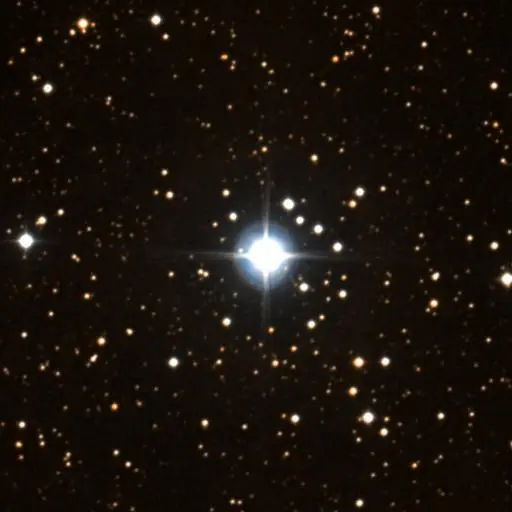
A seven-million-year-old cluster led by a triple star.
At about 7 million years old, NGC 1444 is a baby among star clusters. Its most prominent member is a triple star, Struve 446, catalogued by the double-star observer Friedrich Georg Wilhelm Struve. The cluster belongs to Camelopardalis OB1, a loose association of hot young stars. William Herschel discovered this small open cluster on 18 December 1788.
NGC 1444 is 3,600 light-years away: the light we see from it set off around 1580 BC, 250 years before Tutankhamun was buried in the Valley of the Kings.
How big is it?
Born about 9.8 million years ago, when great apes were spreading through Africa and Europe. Light itself takes 3.8 years to cross it. Gaia has picked out 104 stars moving together through space as its members. That’s about as wide as the distance from the Sun to the nearest star. Shrink our Solar System — the Sun and all eight planets — to the size of a coin, and NGC 1444 would be 95.1 m across (about the length of a football pitch); the nearest star would be a football pitch away, and the Milky Way 2,520 km across.
A 6.6-magnitude open cluster in Perseus, about 3.6′ across.
When and where to see it
It is best placed in the evening sky around December, when it crosses the meridian at about 10 pm local time (around midnight in November). It can be seen from everywhere north of 37°S and never sets north of 37°N.
At its highest it stands 87° up from 50°N, 72° up from 35°N, 37° up from the equator, 2° up from 35°S.
Facts
- Type
- Open cluster
- Constellation
- Perseus
- Designations
- NGC 1444
- Magnitude
- 6.6
- Apparent size
- 3.6′
- Position
- RA 3h 49.5m, Dec +52° 39′ (J2000)
- Distance
- 3,600 light-years
- Discovered
- William Herschel, 1788
Open AstroPilot to see when NGC 1444 is highest tonight from your location, how easy it is with your telescope or binoculars, and an eyepiece view.