Merope Nebula (NGC 1435)
Merope Nebula (NGC 1435) is a reflection nebula in the constellation Taurus, 30′ × 30′ across.
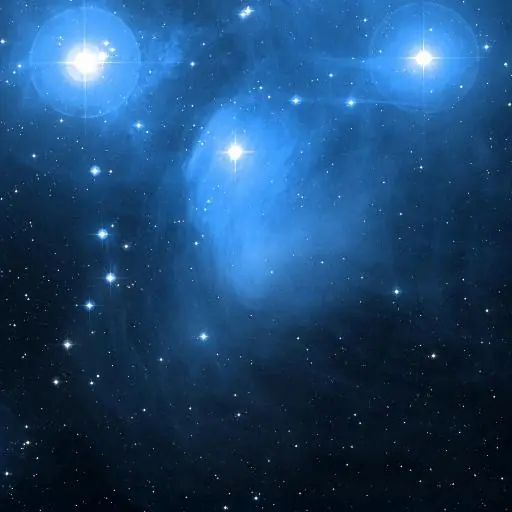
Tempel’s Nebula: the blue haze around Merope — a cloud the Pleiades just happen to be passing through.
For a long time it seemed obvious that the Pleiades were born from the haze around them. They were not. The dust wrapped around Merope belongs to an unrelated cloud that the cluster is drifting through by chance. Fine carbon dust scatters Merope’s light, which is why this reflection nebula looks blue in photographs.
Wilhelm Tempel discovered it on 19 October 1859 with a 10.5 cm refractor, so it is also called Tempel’s Nebula.
Merope Nebula (NGC 1435) is 440 light-years away: the light we see from it set off around 1585, 25 years before Galileo first turned a telescope to the sky.
Did you know?
- Barnard’s knot. Close to Merope lies a bright knot, IC 349, found by E. E. Barnard in November 1890. It is bright in its own right, but almost lost in the glare of the star.
- Listed, never seen. John Herschel included the nebula as number 768 in his General Catalogue of Nebulae and Clusters, though he never observed it himself.
How big is it?
About as wide as the distance from the Sun to the nearest star. Light itself takes 3.8 years to cross it. Shrink our Solar System — the Sun and all eight planets — to the size of a coin, and the Merope Nebula would be 96.9 m across (about the length of a football pitch); the nearest star would be a football pitch away, and the Milky Way 2,520 km across.
A reflection nebula in Taurus, about 30′ across.
When and where to see it
It is best placed in the evening sky around December, when it crosses the meridian at about 10 pm local time (around midnight in November). It can be seen from everywhere north of 66°S and never sets north of 66°N.
At its highest it stands 64° up from 50°N, 79° up from 35°N, 66° up from the equator, 31° up from 35°S.
Facts
- Type
- Reflection nebula
- Constellation
- Taurus
- Designations
- NGC 1435
- Apparent size
- 30′ × 30′
- Position
- RA 3h 46.2m, Dec +23° 46′ (J2000)
- Distance
- 440 light-years
- Discovered
- Wilhelm Tempel, 1859
Open AstroPilot to see when Merope Nebula (NGC 1435) is highest tonight from your location, how easy it is with your telescope or binoculars, and an eyepiece view.