NGC 1433
NGC 1433 is a galaxy in the constellation Horologium, magnitude 9.9, 6.2′ × 3.0′ across.
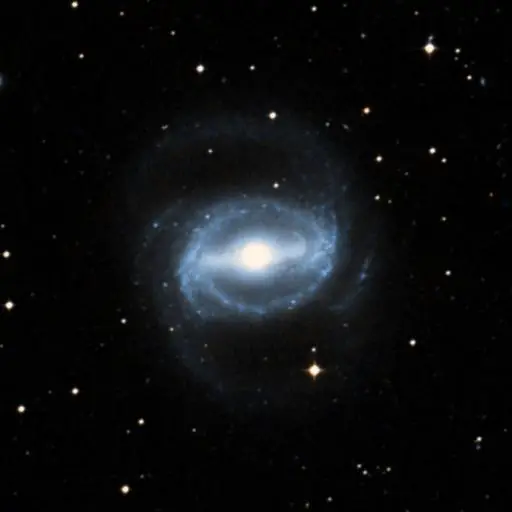
A ringed spiral with an active heart and the smallest molecular outflow seen beyond our galaxy.
Rings within rings mark NGC 1433. It is a barred spiral galaxy with a double ring structure, and close to its centre a small, irregular ring is busy making stars. Its active nucleus drives a jet of molecular gas outwards — the smallest molecular outflow ever seen in a galaxy beyond our own.
NGC 1433 belongs to the Dorado Group and is one of the 50 nearby galaxies in Hubble’s Legacy ExtraGalactic UV Survey. James Dunlop discovered it on 28 September 1826.
NGC 1433 is 26 million light-years away: the light we see from it set off about 26 million years ago, when the Himalayas and the Alps were rising.
How big is it?
47% of the Milky Way’s width. Light itself takes 47,000 years to cross it. Shrink it to the length of a football pitch and our whole Solar System would be about the size of a red blood cell.
A 9.9-magnitude barred spiral galaxy (SBa) in Horologium, about 6.2′ × 3′.
When and where to see it
It is best placed in the evening sky around December, when it crosses the meridian at about 10 pm local time (around midnight in November). It can be seen from everywhere south of 43°N and never sets south of 43°S.
At its highest it stands below the horizon from 50°N, 8° up from 35°N, 43° up from the equator, 78° up from 35°S.
Facts
- Type
- Galaxy
- Constellation
- Horologium
- Designations
- NGC 1433
- Magnitude
- 9.9
- Apparent size
- 6.2′ × 3.0′
- Position
- RA 3h 42.0m, Dec −47° 13′ (J2000)
- Distance
- 26 million light-years
- Discovered
- James Dunlop, 1826
Open AstroPilot to see when NGC 1433 is highest tonight from your location, how easy it is with your telescope or binoculars, and an eyepiece view.