Maia Nebula (NGC 1432)
Maia Nebula (NGC 1432) is a reflection nebula in the constellation Taurus, 1.0° × 40′ across.
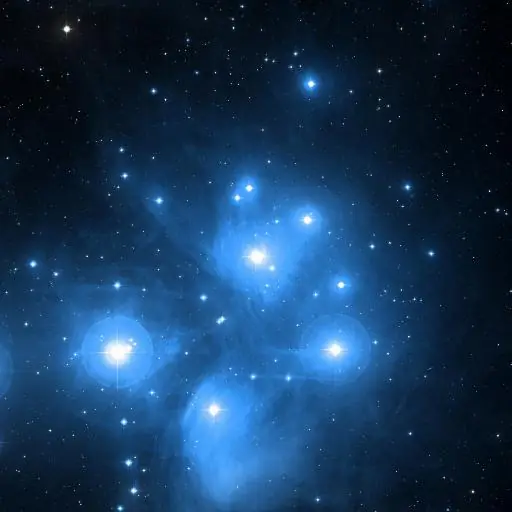
The glow around Maia, one of the Seven Sisters of the Pleiades.
In Greek myth Maia was one of the seven daughters of Atlas and Pleione. The star that carries her name is the fourth-brightest in the Pleiades, and NGC 1432 is the glow around it: a reflection nebula, dust shining by Maia’s blue-white light, one of the brighter patches of nebulosity in the cluster.
Maia itself is a blue giant with odd chemistry: too little helium on its surface, and too much manganese.
Maia Nebula (NGC 1432) is 440 light-years away: the light we see from it set off around 1585, 25 years before Galileo first turned a telescope to the sky.
Did you know?
- The star that named a class. Otto Struve thought Maia varied in brightness and proposed a new class, the Maia variables. Hipparcos found no sign of it, but Kepler later caught a faint 10.3-day flicker, probably a starspot turning with the star.
How big is it?
1.8 times the distance from the Sun to the nearest star. Light itself takes 7.7 years to cross it. Shrink our Solar System — the Sun and all eight planets — to the size of a coin, and the Maia Nebula would be 194 m across (2 football pitches end to end); the nearest star would be a football pitch away, and the Milky Way 2,520 km across.
A reflection nebula in Taurus, about 60′ × 40′.
When and where to see it
It is best placed in the evening sky around December, when it crosses the meridian at about 10 pm local time (around midnight in November). It can be seen from everywhere north of 66°S and never sets north of 66°N.
At its highest it stands 64° up from 50°N, 79° up from 35°N, 66° up from the equator, 31° up from 35°S.
Facts
- Type
- Reflection nebula
- Constellation
- Taurus
- Designations
- NGC 1432
- Apparent size
- 1.0° × 40′
- Position
- RA 3h 45.8m, Dec +24° 22′ (J2000)
- Distance
- 440 light-years
Open AstroPilot to see when Maia Nebula (NGC 1432) is highest tonight from your location, how easy it is with your telescope or binoculars, and an eyepiece view.