NGC 1407
NGC 1407 is a galaxy in the constellation Eridanus, magnitude 9.7, 5.7′ × 5.3′ across.
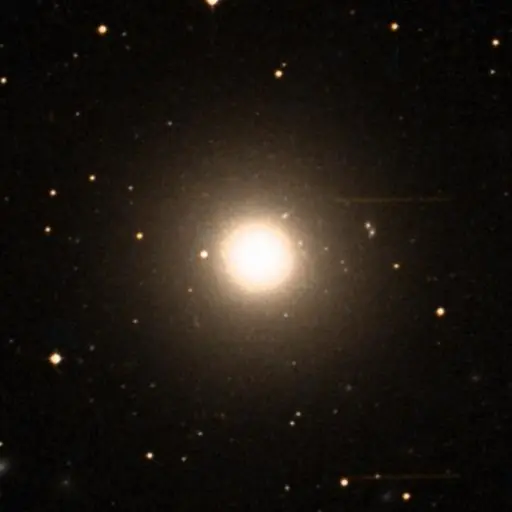
An ancient elliptical galaxy with a billion-Sun black hole that keeps flaring up.
The stars at the heart of NGC 1407 are about 12 billion years old, born when the universe was young, and the galaxy has seen no strong burst of star birth since. This elliptical galaxy is far from asleep, though. At its centre lies a black hole of about a billion times the mass of the Sun, and radio observations show signs of repeated outbursts.
It is the brightest member of its group in Eridanus, followed by its neighbour NGC 1400. William Herschel discovered it on 6 October 1785.
NGC 1407 is 94 million light-years away: the light we see from it set off about 94 million years ago, when dinosaurs still walked the Earth.
How big is it?
1.6 times as wide as our Milky Way. Light itself takes 160,000 years to cross it. Shrink it to the length of a football pitch and our whole Solar System would be smaller than a bacterium.
A 9.7-magnitude elliptical galaxy (E) in Eridanus, about 5.7′ × 5.3′.
When and where to see it
It is best placed in the evening sky around December, when it crosses the meridian at about 10 pm local time (around midnight in November). It can be seen from everywhere south of 71°N and never sets south of 71°S.
At its highest it stands 21° up from 50°N, 36° up from 35°N, 71° up from the equator, 74° up from 35°S.
Facts
- Type
- Galaxy
- Constellation
- Eridanus
- Designations
- NGC 1407
- Magnitude
- 9.7
- Apparent size
- 5.7′ × 5.3′
- Position
- RA 3h 40.2m, Dec −18° 35′ (J2000)
- Distance
- 94 million light-years
- Discovered
- William Herschel, 1785
Open AstroPilot to see when NGC 1407 is highest tonight from your location, how easy it is with your telescope or binoculars, and an eyepiece view.