NGC 1404
NGC 1404 is a galaxy in the constellation Eridanus, magnitude 9.9, 5.0′ × 4.4′ across.
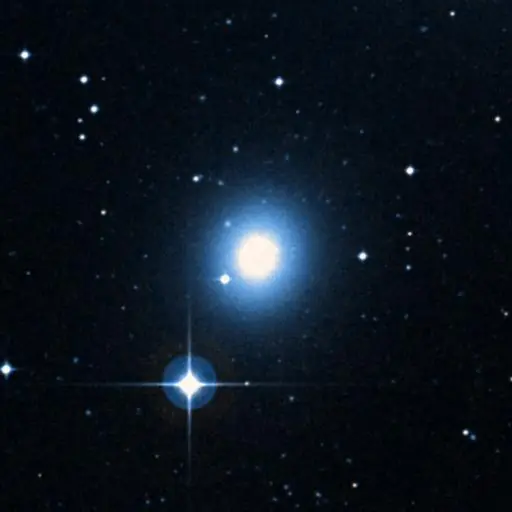
An elliptical galaxy losing its gas — and perhaps its clusters — as it ploughs through the Fornax Cluster.
Like a ship leaving a wake, NGC 1404 trails its own gas. As this elliptical galaxy moves through the thin, hot gas that fills the Fornax Cluster, the pressure strips the galaxy’s hot gas away, and the Chandra X-ray telescope shows it streaming out behind. It may have lost other things too: astronomers have proposed that its giant neighbour NGC 1399 pulled away most of its globular clusters, leaving it about 725.
John Herschel discovered it on 28 November 1837.
NGC 1404 is 68 million light-years away: the light we see from it set off about 68 million years ago, when dinosaurs still walked the Earth.
Did you know?
- Two supernovae in four years. Two Type Ia supernovae have exploded here: SN 2007on in 2007, and SN 2011iv in 2011, found by the New Zealand amateur Stuart Parker.
How big is it?
About as wide as our Milky Way. Light itself takes 99,000 years to cross it. Shrink it to the length of a football pitch and our whole Solar System would be smaller than a bacterium.
A 9.9-magnitude elliptical galaxy (E) in Eridanus, about 5′ × 4.4′.
When and where to see it
It is best placed in the evening sky around December, when it crosses the meridian at about 10 pm local time (around midnight in November). It can be seen from everywhere south of 54°N and never sets south of 54°S.
At its highest it stands 4° up from 50°N, 19° up from 35°N, 54° up from the equator, 89° up from 35°S.
Facts
- Type
- Galaxy
- Constellation
- Eridanus
- Designations
- NGC 1404
- Magnitude
- 9.9
- Apparent size
- 5.0′ × 4.4′
- Position
- RA 3h 38.9m, Dec −35° 36′ (J2000)
- Distance
- 68 million light-years
- Discovered
- John Herschel, 1837
Open AstroPilot to see when NGC 1404 is highest tonight from your location, how easy it is with your telescope or binoculars, and an eyepiece view.