NGC 1398
NGC 1398 is a galaxy in the constellation Fornax, magnitude 9.6, 7.0′ × 4.9′ across.
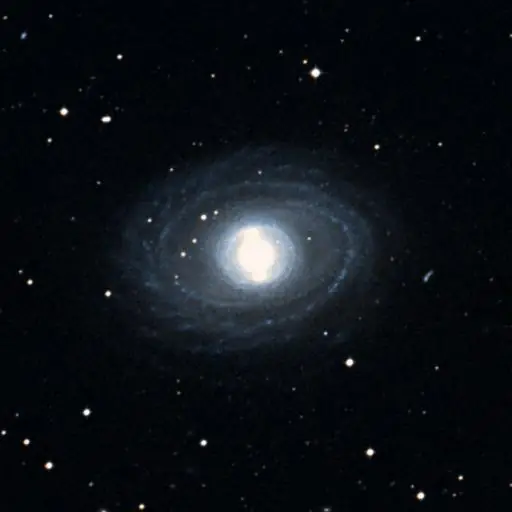
A lone, double-ringed spiral whose discovery is usually credited to the second man to see it.
Wilhelm Tempel saw NGC 1398 first, on 9 October 1861, but did not publish until 1882. Meanwhile Friedrich Winnecke came across it in Karlsruhe on 17 December 1868 while hunting for comets — and he usually gets the credit.
Their find is a barred spiral galaxy with a double ring around its centre. It holds over 100 billion stars and lives in isolation, with no large galaxies close by.
NGC 1398 is 76 million light-years away: the light we see from it set off about 76 million years ago, when dinosaurs still walked the Earth.
How big is it?
1.5 times as wide as our Milky Way. Light itself takes 150,000 years to cross it. Shrink it to the length of a football pitch and our whole Solar System would be smaller than a bacterium.
A 9.6-magnitude barred spiral galaxy (SBab) in Fornax, about 7′ × 4.9′.
When and where to see it
It is best placed in the evening sky around December, when it crosses the meridian at about 10 pm local time (around midnight in November). It can be seen from everywhere south of 64°N and never sets south of 64°S.
At its highest it stands 14° up from 50°N, 29° up from 35°N, 64° up from the equator, 81° up from 35°S.
Facts
- Type
- Galaxy
- Constellation
- Fornax
- Designations
- NGC 1398
- Magnitude
- 9.6
- Apparent size
- 7.0′ × 4.9′
- Position
- RA 3h 38.9m, Dec −26° 20′ (J2000)
- Distance
- 76 million light-years
- Discovered
- Wilhelm Tempel, 1861, Often credited to Friedrich Winnecke, who found it in 1868; Tempel did not publish until 1882
Open AstroPilot to see when NGC 1398 is highest tonight from your location, how easy it is with your telescope or binoculars, and an eyepiece view.