NGC 1365
NGC 1365 is a galaxy in the constellation Fornax, magnitude 10.1, 12′ × 6.1′ across.
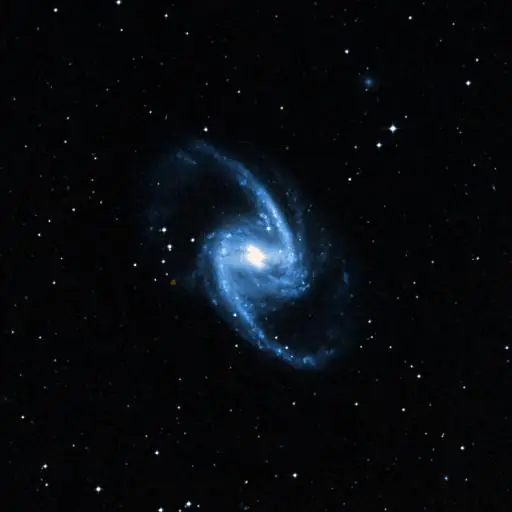
The Great Barred Spiral: a bar within a bar, feeding a black hole that spins near light speed.
A great bar of stars cuts across the centre of NGC 1365, and inside it lies a second, smaller bar that turns faster than the first. The bar acts like a funnel, drawing gas and dust into a whirl of star birth and feeding the black hole at the centre. Out at its tips, the bar takes about 350 million years to turn once.
About two thirds of spiral galaxies have bars, and our own Milky Way is thought to be one of them, so this spiral galaxy is a window on home. James Dunlop discovered it on 2 September 1826.
NGC 1365 is 58 million light-years away: the light we see from it set off about 58 million years ago, when mammals were taking over a world without dinosaurs.
Did you know?
- A spinning black hole. In 2013 the NuSTAR X-ray telescope showed that its central black hole, about half the mass of the Milky Way’s, is spinning at close to the speed of light.
- A supernova regular. The Australian supernova hunter Robert Evans found two of the four supernovae seen in NGC 1365, in 1983 and 2001.
How big is it?
2 times as wide as our Milky Way. Light itself takes 200,000 years to cross it. Shrink it to the length of a football pitch and our whole Solar System would be smaller than a bacterium.
A 10.1-magnitude spiral galaxy (Sb) in Fornax, about 12′ × 6.1′.
When and where to see it
It is best placed in the evening sky around December, when it crosses the meridian at about 10 pm local time (around midnight in November). It can be seen from everywhere south of 54°N and never sets south of 54°S.
At its highest it stands 4° up from 50°N, 19° up from 35°N, 54° up from the equator, 89° up from 35°S.
Facts
- Type
- Galaxy
- Constellation
- Fornax
- Designations
- NGC 1365
- Magnitude
- 10.1
- Apparent size
- 12′ × 6.1′
- Position
- RA 3h 33.6m, Dec −36° 8′ (J2000)
- Distance
- 58 million light-years
- Discovered
- James Dunlop, 1826
Open AstroPilot to see when NGC 1365 is highest tonight from your location, how easy it is with your telescope or binoculars, and an eyepiece view.