NGC 1360
NGC 1360 is a planetary nebula in the constellation Fornax, magnitude 9.4, 6.4′ across.
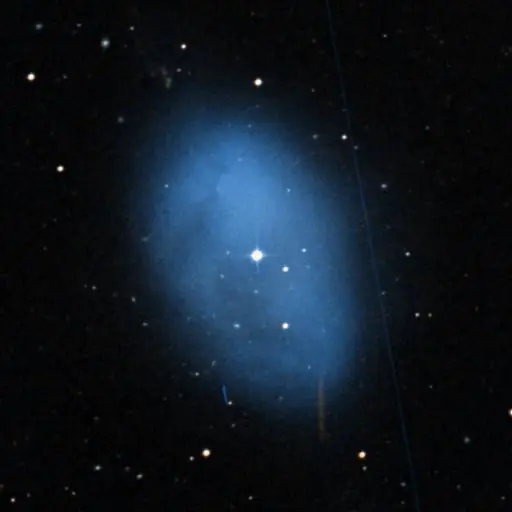
The Robin’s Egg Nebula: a dying star’s shell, and a central ‘star’ that turned out to be two.
The Robin’s Egg Nebula is a fitting name for a cloud that shines strongly in the blue-green light of oxygen. NGC 1360 is a planetary nebula, the shed outer layers of a star near the end of its life. Reddish wisps around it are thought to be material the star threw off before its final collapse.
Friedrich Winnecke discovered it in January 1868.
NGC 1360 is 1,300 light-years away: the light we see from it set off around AD 730, 75 years before Charlemagne was crowned emperor.
Did you know?
- Two hearts. Its central star was suspected to be double in 1977, but proof took until 2017. It is a hot O-type star paired with a white dwarf — and the white dwarf is the heavier of the two.
How big is it?
2,550 Solar Systems side by side. Light itself takes 2.4 years to cross it. Shrink our Solar System — the Sun and all eight planets — to the size of a coin, and NGC 1360 would be 61.3 m across (about the length of an Olympic pool); the nearest star would be a football pitch away, and the Milky Way 2,520 km across.
A 9.4-magnitude planetary nebula in Fornax, about 6.4′ across. Its central star is magnitude 11.4.
When and where to see it
It is best placed in the evening sky around December, when it crosses the meridian at about 10 pm local time (around midnight in November). It can be seen from everywhere south of 64°N and never sets south of 64°S.
At its highest it stands 14° up from 50°N, 29° up from 35°N, 64° up from the equator, 81° up from 35°S.
Facts
- Type
- Planetary nebula
- Constellation
- Fornax
- Designations
- NGC 1360
- Magnitude
- 9.4
- Apparent size
- 6.4′
- Position
- RA 3h 33.2m, Dec −25° 52′ (J2000)
- Distance
- 1,300 light-years
- Discovered
- Friedrich Winnecke, 1868
Open AstroPilot to see when NGC 1360 is highest tonight from your location, how easy it is with your telescope or binoculars, and an eyepiece view.