NGC 1340 (NGC 1344)
NGC 1340 (NGC 1344) is a galaxy in the constellation Fornax, magnitude 10.4, 5.1′ × 3.1′ across.
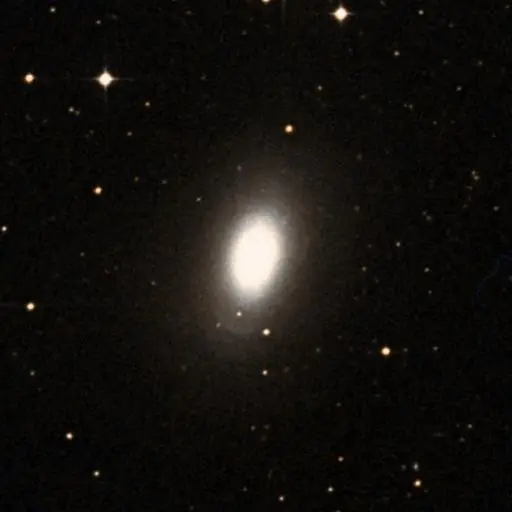
Two Herschels, two numbers, one galaxy.
William Herschel found this elliptical galaxy in 1790. On 19 November 1835 his son John observed it, and his sighting was later treated as a separate object. Dreyer’s New General Catalogue ended up listing both: NGC 1344 for William’s observation and NGC 1340 for John’s. Today the galaxy is known to belong to the group around NGC 1399, the central galaxy of the Fornax Cluster — a family of at least 42 galaxies.
NGC 1340 (NGC 1344) is 64 million light-years away: the light we see from it set off about 64 million years ago, when mammals were taking over a world without dinosaurs.
How big is it?
About as wide as our Milky Way. Light itself takes 95,000 years to cross it. Shrink it to the length of a football pitch and our whole Solar System would be smaller than a bacterium.
A 10.4-magnitude elliptical galaxy (E) in Fornax, about 5.1′ × 3.1′.
When and where to see it
It is best placed in the evening sky around December, when it crosses the meridian at about 10 pm local time (around midnight in November). It can be seen from everywhere south of 59°N and never sets south of 59°S.
At its highest it stands 9° up from 50°N, 24° up from 35°N, 59° up from the equator, 86° up from 35°S.
Facts
- Type
- Galaxy
- Constellation
- Fornax
- Designations
- NGC 1344
- Magnitude
- 10.4
- Apparent size
- 5.1′ × 3.1′
- Position
- RA 3h 28.3m, Dec −31° 4′ (J2000)
- Distance
- 64 million light-years
- Discovered
- William Herschel, 1790, John Herschel’s 1835 sighting became the duplicate entry NGC 1340
Open AstroPilot to see when NGC 1340 (NGC 1344) is highest tonight from your location, how easy it is with your telescope or binoculars, and an eyepiece view.