NGC 134
NGC 134 is a galaxy in the constellation Sculptor, magnitude 10.3, 8.4′ × 1.8′ across.
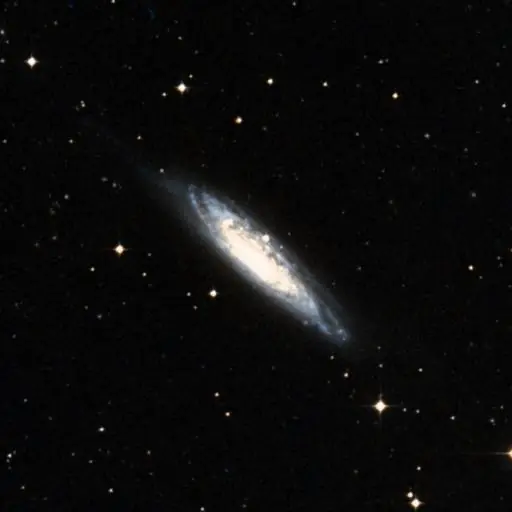
The Giant Squid Galaxy: a Milky Way look-alike with a warped disc and a trail of stripped gas.
Stephen James O’Meara suggested a nickname for NGC 134: the Giant Squid Galaxy. It is a barred spiral galaxy much like our own Milky Way, its arms loosely wrapped around a bright central bar. Red patches along those arms mark clouds where new stars are being born.
Seen from the side, its disc is not flat but warped, and a trail of gas is being stripped from one edge. Both hint that another galaxy once disturbed it, though that remains unproven. It belongs to a small group of galaxies that includes NGC 131 and NGC 148.
NGC 134 is 57 million light-years away: the light we see from it set off about 57 million years ago, when mammals were taking over a world without dinosaurs.
Did you know?
- Who saw it first?. Credit often goes to John Herschel at the Cape of Good Hope, but Herschel himself noted that it might be object 590 in James Dunlop’s catalogue, published in 1828 — six years before his own observations.
- An amateur’s supernova. On 20 June 2009 New Zealand amateur astronomer Stuart Parker discovered a supernova in NGC 134, SN 2009gj: the explosion of a massive star.
How big is it?
1.4 times as wide as our Milky Way. Light itself takes 140,000 years to cross it. Shrink it to the length of a football pitch and our whole Solar System would be smaller than a bacterium.
A 10.3-magnitude weakly barred spiral galaxy (SABb) in Sculptor, about 8.4′ × 1.8′.
When and where to see it
It is best placed in the evening sky around November, when it crosses the meridian at about 10 pm local time (around midnight in October). It can be seen from everywhere south of 57°N and never sets south of 57°S.
At its highest it stands 7° up from 50°N, 22° up from 35°N, 57° up from the equator, 88° up from 35°S.
Facts
- Type
- Galaxy
- Constellation
- Sculptor
- Designations
- NGC 134
- Magnitude
- 10.3
- Apparent size
- 8.4′ × 1.8′
- Position
- RA 0h 30.4m, Dec −33° 15′ (J2000)
- Distance
- 57 million light-years
- Discovered
- James Dunlop, 1826, Often credited to John Herschel, who noted Dunlop may have seen it first
Open AstroPilot to see when NGC 134 is highest tonight from your location, how easy it is with your telescope or binoculars, and an eyepiece view.