NGC 1333
NGC 1333 is a cluster + nebula in the constellation Perseus, magnitude 10.9 (blue), 20′ across.
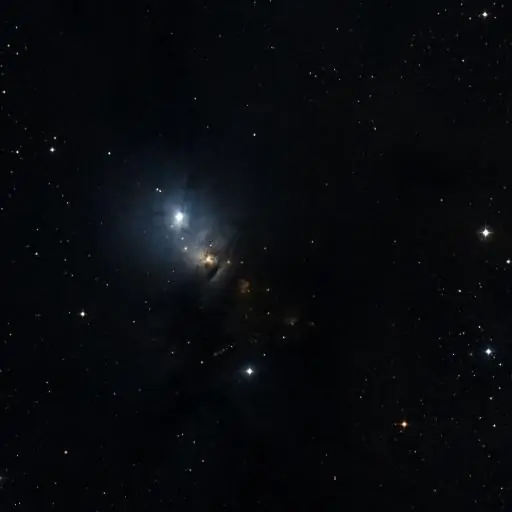
The Embryo Nebula: a nursery of newborn stars — and of planet-sized objects with no star at all.
A stellar nursery caught in the act: that is NGC 1333. Inside this dusty reflection nebula, in the western part of the Perseus molecular cloud, about 150 stars have formed with a median age of only a million years — infants beside the 4.6-billion-year-old Sun. Twenty young stars are blasting out jets and outflows of gas, and many are still contracting towards adulthood. Its nickname, the Embryo Nebula, fits.
Eduard Schönfeld discovered it in 1855.
NGC 1333 is 950 light-years away: the light we see from it set off around 1075, around the time Chinese astronomers recorded the supernova that made the Crab Nebula.
Did you know?
- Planets without stars. The cloud holds objects only a few times the mass of Jupiter, drifting free. In 2024 the James Webb Space Telescope found several but none below about 4 Jupiter masses — hinting that star-like births may not make anything smaller.
- A tiny world with a disc. One of them, NIRISS-NGC1333-5, weighs about 5 Jupiters yet shows signs of a disc around it, making it one of the lowest-mass objects known to have one.
How big is it?
Born about 11 million years ago, when great apes were spreading through Africa and Europe. Light itself takes 5.4 years to cross it. Gaia has picked out 31 stars moving together through space as its members. That’s 1.3 times the distance from the Sun to the nearest star. Shrink our Solar System — the Sun and all eight planets — to the size of a coin, and NGC 1333 would be 136 m across (about the length of a football pitch); the nearest star would be a football pitch away, and the Milky Way 2,520 km across.
A star cluster with nebulosity in Perseus, about 20′ across. Its catalogued magnitude, 10.9 (B-band), is that of the star cluster; the nebulosity is much fainter.
When and where to see it
It is best placed in the evening sky around December, when it crosses the meridian at about 10 pm local time (around midnight in November). It can be seen from everywhere north of 59°S and never sets north of 59°N.
At its highest it stands 71° up from 50°N, 86° up from 35°N, 59° up from the equator, 24° up from 35°S.
Facts
- Type
- Cluster + nebula
- Constellation
- Perseus
- Designations
- NGC 1333
- Magnitude
- 10.9 (blue)
- Apparent size
- 20′
- Position
- RA 3h 28.9m, Dec +31° 22′ (J2000)
- Distance
- 950 light-years
- Discovered
- Eduard Schönfeld, 1855
Open AstroPilot to see when NGC 1333 is highest tonight from your location, how easy it is with your telescope or binoculars, and an eyepiece view.