NGC 1332
NGC 1332 is a galaxy in the constellation Eridanus, magnitude 10.4, 5.3′ × 3.8′ across.
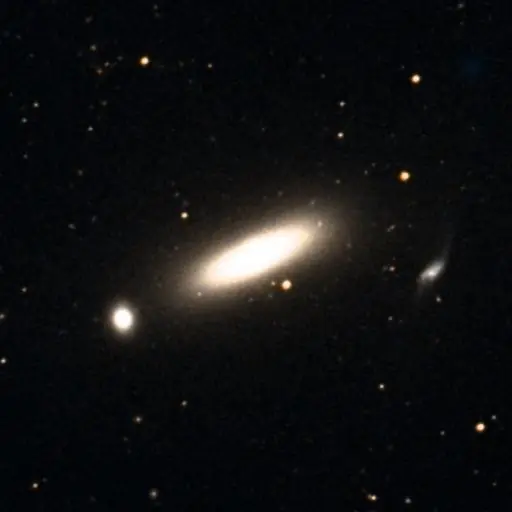
A galaxy with one of the most precisely weighed black holes: about 660 million Suns.
Weighing a black hole precisely is hard. In 2016 a team from the United States and China used the ALMA radio telescope array to study the core of NGC 1332 in fine detail, and pinned its black hole at about 660 million times the mass of the Sun, give or take just 10 percent. It is the heaviest black hole known in the Eridanus Cluster, outweighing even the one in NGC 1399, the central galaxy of the Fornax Cluster.
NGC 1332 is an elliptical galaxy of old, red stars, the brightest in its own small group. William Herschel discovered it on 9 December 1784.
NGC 1332 is 75 million light-years away: the light we see from it set off about 75 million years ago, when dinosaurs still walked the Earth.
How big is it?
1.2 times as wide as our Milky Way. Light itself takes 120,000 years to cross it. Shrink it to the length of a football pitch and our whole Solar System would be smaller than a bacterium.
A 10.4-magnitude elliptical/lenticular galaxy (E-S0) in Eridanus, about 5.3′ × 3.8′.
When and where to see it
It is best placed in the evening sky around December, when it crosses the meridian at about 10 pm local time (around midnight in November). It can be seen from everywhere south of 69°N and never sets south of 69°S.
At its highest it stands 19° up from 50°N, 34° up from 35°N, 69° up from the equator, 76° up from 35°S.
Facts
- Type
- Galaxy
- Constellation
- Eridanus
- Designations
- NGC 1332
- Magnitude
- 10.4
- Apparent size
- 5.3′ × 3.8′
- Position
- RA 3h 26.3m, Dec −21° 20′ (J2000)
- Distance
- 75 million light-years
- Discovered
- William Herschel, 1784
Open AstroPilot to see when NGC 1332 is highest tonight from your location, how easy it is with your telescope or binoculars, and an eyepiece view.