NGC 1326
NGC 1326 is a galaxy in the constellation Fornax, magnitude 10.4, 4.3′ × 2.9′ across.
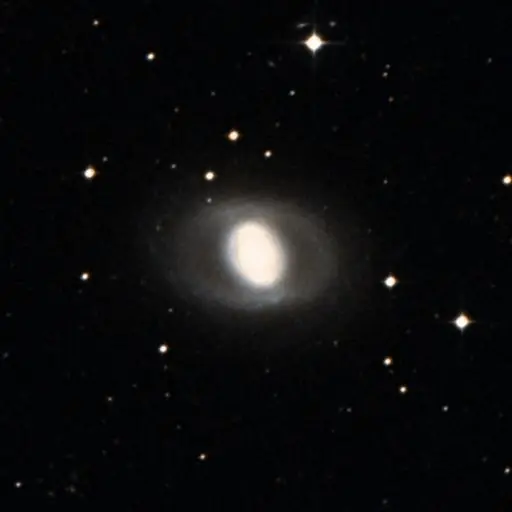
A lenticular galaxy in the Fornax Cluster with a ring around its heart.
A small ring circles the centre of NGC 1326. It is a lenticular galaxy — a disc with little sign of spiral arms — and a member of the Fornax Cluster, in the subgroup around NGC 1316. On paper it is an ordinary early-type lenticular, yet it is very different from the others of its kind in the cluster. John Herschel discovered it on 29 November 1837, during his years observing the southern sky from the Cape of Good Hope.
NGC 1326 is 52 million light-years away: the light we see from it set off about 52 million years ago, when mammals were taking over a world without dinosaurs.
How big is it?
65% of the Milky Way’s width. Light itself takes 65,000 years to cross it. Shrink it to the length of a football pitch and our whole Solar System would be smaller than a bacterium.
A 10.4-magnitude lenticular galaxy (S0-a) in Fornax, about 4.3′ × 2.9′.
When and where to see it
It is best placed in the evening sky around December, when it crosses the meridian at about 10 pm local time (around midnight in November). It can be seen from everywhere south of 54°N and never sets south of 54°S.
At its highest it stands 4° up from 50°N, 19° up from 35°N, 54° up from the equator, 89° up from 35°S.
Facts
- Type
- Galaxy
- Constellation
- Fornax
- Designations
- NGC 1326
- Magnitude
- 10.4
- Apparent size
- 4.3′ × 2.9′
- Position
- RA 3h 23.9m, Dec −36° 28′ (J2000)
- Distance
- 52 million light-years
- Discovered
- John Herschel, 1837
Open AstroPilot to see when NGC 1326 is highest tonight from your location, how easy it is with your telescope or binoculars, and an eyepiece view.